• About Me
  • Contact
  • Links to other stuff I’ve written
  • Useful Links

Nina Childish

~ and various brain kittens

Nina Childish

Category Archives: Blog

The Medication Postcode Lottery

20 Wednesday Mar 2024

Posted by ninachildish in Blog, Disability, health, Uncategorized

≈ 1 Comment

Tags

Blog, chronic fatigue, chronic-pain, health, heart failure, medication, Mental Health, NHS, personal

We’ve lived here in this small city for 8 months now, owned the house for 9 months – not that you’d know it with us not even being fully unpacked, rooms half painted and half-finished. Despite our slow progress, it’s been easy to settle into life here. Our neighbourhood is calm but cheery. The right mix of students and families. Norwich doesn’t have an awful lot going on, at least compared to London, so there’s less choice when it comes to gigs and theatre, but at least we have some choice at all even if the University is the largest music venue on offer! It doesn’t lack in independent coffee shops and record stores, either. Change hasn’t been so hard, I was expecting more pushback from my subconscious. Maybe it’s just that our home is so lovely it’s making it so much easier to adapt. At least for the most part. Nothing is ever actually so simple…

I knew when we moved I’d have to shuffle some medical stuff around. A few things would have to be re-referred up here, but some would stay based in London where the speciality centres were. I wasn’t expecting to find myself a victim of NHS postcode lottery, though. My new GP flagged it up almost immediately when reviewing my medication list – “oh, that might be an issue…”. Modafinil. It’s a narcolepsy medication, which my cardiologist prescribed to me off-label near the end of 2020 in the hopes it would help the crushing fatigue and cut through the brain fog a bit, give me more ‘useful hours’ to work with. It’s not a miracle drug but has made a marked difference to me, especially in terms of preventing ‘rebound naps’ within a few hours of getting up (which used to be almost daily) and in the amount of focus I have (already terrible thanks to unmedicated ADHD, brain fog makes it far worse). On Norfolk’s NHS prescription board, however, Modafinil is Double Red listed (I presume based on abuse potential, not cost), which means it can only be prescribed for narcolepsy and must be prescribed by a specialist in this disorder. This obviously doesn’t include me. I’ve appealed to the board twice via my GP, but to no avail. My next options are to wait 6 months for my next cardiology review to see if they can prescribe it to me directly again (unlikely as they prefer your GP to do this after the trial prescription) or to pay for a private GP appt and private prescription (expensive to the point of being unsustainable long term). Getting some kind of delayed reprieve from the board based on having taken the medication successfully for three years with only positive effects is, sadly, unlikely to happen.

So as of now, I’ve been almost three months without the medication that helped me manage a bit more like a functioning person. For a month or so as I was running out I picked the days I wanted to take the Modafinil, based on how long I’d have to be awake or how much I needed to do that day, and took my last dose on Christmas Day. Inevitably I started spiralling a bit as I reached the last dose, anxious about losing what function, what hours of clarity and ability I had. It’s been better than I’d feared, in reality, but it’s been quite foggy and I don’t feel my year really started until mid-February. It’s nearly the end of March now and this is the most I’ve written at once so far this year (two coffees don’t really have the same effect). Before this happened, I had no idea the kinds of medications that could be affected by moving to a different NHS prescribing area; I thought it was something that only affected expensive procedures like IVF, or expensive drugs for very specific cancers. I knew that some treatments weren’t available in all areas; years of hitting a brick wall with trying to get the recommended hydrotherapy in my London borough come to mind. It never occurred to me, though, that I should double check that I’d still be able to take all my prescribed medication when I moved within the same country!

It feels pretty cruel when it comes down to it, taking away something that was helping me be more productive, less fatigued, more me. I feel sometimes like I wasted a lot of those three years taking the medication, not learning or studying or writing enough, when it might have been as un-fatigued as I was ever going to get. I’m certainly not giving up my quest to get it back, but there’s not going to be a solution that’s both quick and inexpensive.

The Accessible Home Project pt1: The Stairlift

09 Wednesday Aug 2023

Posted by ninachildish in Blog, Disability

≈ Leave a comment

Tags

accessibility, accessible home project, disability, personal, stairlift

We have a house. We own a house. I’m still reeling a bit at that fact, and also at the sudden financial necessities like replacing the old immersion tank and getting someone in to look at the spare room to find the cause of that weird smell (is it damp? is it coming from the loft we can’t get into because there’s no ladder?). The costs I was anticipating, though, the ones we knew were coming from the start, are the ones needed to make this lovely little house into one I can live in independently and safely. Before we decided to buy this house, before we decided to buy a house as opposed to any other type of residence, we knew there’d be a number of costs involved to make it suitably accessible. While looking for a home to share together we quickly had to scrap the dream idea of a bungalow as the only ones within reasonable walking/rolling distance of the city, although stunning, were 100k out of budget. We did find one right by the city on its own large plot of land, but we had both decided we’d like some neighbours, and couldn’t take on a fixer-upper either. Neither of us are particularly skilled at home renovations, for my part not even those that can be done from a seated position! Flats, too, quickly disappeared from our searches. Older more characterful flats were invariably not wheelchair accessible from the street, and the affordable newer ones too small – plus we worried about noise issues and lifts breaking, both things notorious in apartment buildings, not to mention increasing service charges. It made more sense to buy a house and spend a lump sum of money making it suitably accessible to last the next 10+ years than to pay increasing charges year on year for somewhere that wasn’t our first choice.

So what needs doing? The list has three major things, and a couple of minor things that we can mostly buy/install ourselves. Of the majors, the stairlift was the obvious priority, followed by replacing the back door with a level access one as my wheelchair takes up most of the width of the front hallway at the moment. Installing a downstairs loo and shower room in the current cloakroom is a much larger and more expensive project so will be done last. After making enquiries, we were cautiously optimistic that Richard, the lovely surveyor from Norfolk Stairlifts, would approve our creaky wooden stairs, as the previous owners told us that there’d been one installed when they bought the property, so we knew the stairs had fit one at some point. Soon after our home assessment I visited the showroom and tried out the suitable model of stairlift for very narrow stairs, and one with the manual swivel mechanism that our equally narrow landing demands if I want to avoid constantly bashing my knees into the wall. It’s going to be a tight fit for both me and for anyone using the stairs, but it can be done. I’d been managing the stairs for the month since we moved in, but it was difficult and causing some painful and sleepless nights. It’s also no fun rationing drinks to avoid having to go upstairs to the loo too often, then sitting down for a wee on screaming hips with a heart rate of 110.

The stairs soon after we moved in (you can just about see my wheelchair charger at the bottom!)

The very good news about the stairlift is that it was about half the cost of what we’d thought it would be as we didn’t need a curved rail, so I could pay for it myself without needing any contribution from Chris for something that he won’t use and will probably find himself infuriated by at times. The less good news about all our access renovations is that we don’t qualify for any help towards costs. I plan on expanding on this in another post, but the council’s Healthy Homes scheme approves financial aid primarily based on receipt of certain benefits and I lost all hope of getting back on ESA when I moved in with a partner because [rant about the system saved for other post]. To decide eligibility without these benefits, they look at income; again, both mine and his. I didn’t think we’d stand a chance based on his income, but at least I have enough in those savings to cover the stairlift and maybe half a door largely thanks to Arriva London Buses. I might even be able to keep my Emergency Wheelchair Fund untouched, which would be ideal as my current one is slowly rattling off this mechanical coil. I do find it frustrating on his behalf that Chris is having to pay for some of the access fixes, but at least he will use the back door and the downstairs bathroom. Despite his reassurances I’m still trying to swallow the Disabled Partner Guilt (which, again, is for another post).

The stairlift is being installed as I type. I’m marooned upstairs while this is happening as Ronnie, the technician, needs the stairs clear for all his equipment and we only have the one bathroom for now. Chris has escaped to work in the coffee shop to avoid the noise and disruption but it’s not been too loud so far (I can always put my headphones on). It takes 4-5 hours, which seems a very long time, but everything has to be measured and done so precisely (conversely, I’m told it takes under an hour to remove a basic straight stairlift!). A few hours doing chores from bed is a small price to pay for years of better accessibility in my own home!

Update:
The stairlift that best suited my needs is a Handicare 1100. It’s very slim and the rail sits relatively close to the wall which leaves just over half the stairwell free for pedestrians. The rail is straight because the hallway and landing are also very narrow (as in most Victorian terraces) so I find it best to use the external remote control to move the chair a few steps up after I’ve come downstairs or else it gets in the way of the kitchen door. Once I’m at the top or bottom of the stairs, I pull a little lever under the seat to swivel the chair around (using the bannister to push myself) so I can get off. There’s a little switch under one arm to raise or lower the footrest, and there is a seatbelt which they recommend is used (but won’t revoke the stairlift if you don’t). There’s also a key which you can use to lock it, meaning when our toddler nephew visits he won’t be able to take himself for a ride on Auntie Nina’s Fun Chair. We were very happy to find that the stairlift would not come into contact with the two plug sockets at the bottom of the stairs – there was no need to drill through into the kitchen, and I can still use the second socket for charging my powerchair until we make it a base in the utility room. It’s not too noisy either, just a droning hum that sounds a bit like electronic bagpipes to my mind! It would be quieter if we had carpet, but we’re not sure we want any carpeting in the house yet let alone on the stairs – Ronnie tells me that he’s worked a few jobs installing complicated stairlifts when the client casually mentions they’re getting the carpets redone in a month! I promised him if we did get carpet it would just be a runner. We have 101 more things to get done before we even think about the stairs anyway.

Here’s what it looks like in our house:

Now, onto the back doors – and the never-ending task of choosing paint colours!

burning

20 Thursday Jul 2023

Posted by ninachildish in Blog, Mental Health

≈ Leave a comment

Tags

abuse, history, sexual abuse, telling a story, the past

When I was 20 I burned a book, something I had previously thought total anathema. When I uncovered it in the box of stuff handed over when my mum moved back to the UK, I was physically sick. I couldn’t touch it, read the words, I could hardly bear to have it in my possession it was so tainted.

A friend came over that evening and made the suggestion. I was surprised at how easily I accepted it, but my love of books and obsessive holding onto them was well outmatched by my revulsion of this particular copy. So we burned it in my little patio garden, with hairspray and her zippo lighter, and I watched the flakes of charred paper rise and blow away.

I didn’t want to just throw it out, or give it to a charity shop so someone else could read it to their child, as it had been read to me once before… before other things. I just wanted it not to physically exist any more, the way I had wanted not to, and for a while my demons burned with it.

somewhere in Enfield, 2006

(n.b. always burn cursed objects in a well ventilated area)

The Good Samaritan

16 Tuesday Mar 2021

Posted by ninachildish in Blog, Disability

≈ 4 Comments

Tags

disability, harassment, London, police, safety

I wrote this a year ago, the night it happened. I wanted to get the details down while they were fresh in my memory, but as it turns out this didn’t matter. A police officer came to my home a few days later, and told me that because the incident had happened off the bus they couldn’t use the bus CCTV to try and identify the man because it would “violate his right to privacy”. The (male) police officer also suggested that the man might have honestly “just been trying to help”. Because of lockdown and my health risks, I’ve not been on a bus since and that’s been the best help in dealing with this. I’ve decided to post it now, though, because of the outpouring of stories women have been sharing since Sarah Everard was killed and because disabled women are at risk too – often under the guise of “assistance” like this. 

Two men are facing me, sitting in seats separated by the aisle; it was clear they’d been having a conversation, thrown together by late night commute. Talk quickly turned to the wheelchair ramp, which didn’t want to go back in. We sat while the alarm beeped and the recalcitrant ramp moved a few centimetres at a time towards its goal, sharing weary head-shakes, eye rolls, “oh TFL” sardonic grins, until eventually the bus was able to move off. I learned on the short journey that the man on my right was heading somewhere unfortunately far off the night bus route and not looking forward to the 40 minute walk. The man on my left asked me some questions, none about my disability, which I answered coolly but politely (my age, why I was out so late, if I needed help). It’s ingrained in me not to ignore questions, even from strangers. Say something or it’s rude, but include as little information as possible if you don’t feel like a conversation. Politeness will get you everywhere, including into trouble.

At my stop the ramp deployed properly but then, of course, refused to return to position. The driver got out of the bus, and excused me from trying to assist. Wishing him the best of luck, I got around the corner of my road before stopping for a minute to answer a message on my phone with my dominant hand, the one I use to control my wheelchair. I can hear someone coming up behind me, and move over a bit to let them pass with more room.

“Hello!”
To my surprise the man from the left hand side of the bus is walking up to me.
“I just wondered, did you need any help?”
I didn’t remember him getting off the bus at my stop, but maybe since the ramp was taking its sweet time going back in, he had time to come and ask – many non-disabled people offer me assistance like this in the average week, both underestimating the power of my electric wheelchair and the extent of TFL’s accessibility infrastructure (if you’ve never needed to use a wheelchair ramp on the bus, for example, you may presume the driver is about to leave without letting a wheelchair user off, but the doors need to close for the ramp to be deployed).
I said no thank you to his offer of help, and this where most people stop.
“But you must need help!”
Again, no thank you, I explained that I manage this journey into the city and back multiple times a week (slight embellishment for emphasis on my independence) and don’t need help getting into my own home. He changed tack:
“What is your name?”
I couldn’t pretend to be distracted this time. My mind sticks on Elly Higginbottom. “Elizabeth”.
“Elizabeth… Elizabeth, oh Elizabeth…”
the wavering red flag I’ve felt since he appeared on my road suddenly springs upright
“I think you should probably go back to the bus” (although I was vaguely aware of having heard it drive off a moment before) “you don’t want to miss it”
“Let me help you, Elizabeth”
He speaks gently, but as if he’s already decided on the course of action and he’s just asking first because it’s a social norm.
“No it’s okay, I’ve been travelling on my own since I was a teenager, I don’t need help”
“No Elizabeth, where do you live? Do you live here?”
Deflect, deflect, deflect (and lie) “About five minutes away, look it’s nearly 1am I just want to go home and go to bed it’s really late, so…”
“Can I come with you, walk with you?”
At this point, I am acutely aware that the late hour means that most of the people on my residential road are in bed. Footfall is minimal, as are passing cars. My wheelchair has lost some battery over the course of the evening and is now running at a medium-fast walking pace at best. The priority is not to let him know where I live, which means cutting contact with him there at the end of the road.
Direct, direct, direct “No, sorry. I just want to go home, have a cup of tea and go to bed”
This seems to encourage him in a new direction, unfortunately.
“Can I come home with you and have a cup of tea?
“No, sorry.”
“I can stand outside even, not in the house, just a cup of tea”
“No” – no more “sorry”, because the red flag is getting ominously brighter
“Coffee”
“No, I just want to go home and go to bed”
“Can I not come for one cup of tea?”
“No, sorry [argh] I’m not going to take a stranger home with me in the middle of the night” (slight lie, ask my second year housemates)
“But I won’t be a stranger soon, we are at the beginning of something”
fifty fucking red flags are waving in my face
Now desperate, and not sure when I went from feeling hassled to actively scared, I try to override my British-Canadian double whammy of natural politeness and the wobble in my voice.
“Leave me alone please. I don’t want you to come home with me and I don’t want to talk to you any more.” Said as forcefully as possible, being very aware to put on an apologetic smile at the end to dampen the rejection. Everything in me is screaming “don’t make him angry” so the urge to just keep him placated is overwhelming, but also things have been slowly escalating in the last three minutes and I am very worried about where they might end up. I start to silently pray for someone to come walking past.
“You don’t need to speak aggressively to me Elizabeth” I think I do
Since he mentioned coming to my home I’ve been thinking of what is open at this hour nearby on a weeknight. Nothing on the parade of shops to the left, the corner shop closed two hours ago. The pub on the right? No one’s in the beer garden having a smoke, so I can presume the doors are locked. I’d have to roll 15 minutes into town to find anywhere open, and he already knows that isn’t my way home.
In utter desperation I use my last card.
“If you don’t leave me alone, I’m going to have to call the police”
“You don’t have to do that, Elizabeth, I am not-“

I see a man on the other side of the road, strolling briskly in the direction of my flat. I immediately cross the road (thank heavens I stopped on a drop kerb) and go after him, occasionally shouting to try and get his attention, but he is wearing headphones and doesn’t hear either me or my high-pitched (and usually ineffective) wheelchair horn. I follow him for close to five minutes, passing my house on the other side, never getting closer than 2 metres away thanks to the reduced battery life, and too scared to turn around to see if there’s a figure in a red hoodie following me. I think about calling the police but don’t think their priority in North London at night is to come to the aid of someone who may or may not be being followed, and in any case the local station closed down years ago and it could take hours. By the time the man with the headphones crosses the road at a point where I can’t follow him, never knowing that I tried to get his attention, I’ve made a list in my head of anyone I know nearby who might be awake (but still probably isn’t). I can’t hear footfalls over the sound of my wheelchair, but I don’t want to stop so I take a convoluted route through the residential side streets, making sure that if he’s still following me I could still be feasibly “going home” (and realising that I am still considering his feelings although I can’t tell if it’s out of tact or fear of angering him). Eventually I stop and look back. Nothing. He hasn’t followed me. My only worry now is that if he was savvy enough he might have gone up and down my road looking for a wheelchair ramp. I call my upstairs neighbour, guiltily aware that I will most likely be waking him up, but after three attempts realise his phone must be on silent. Scanning mentally through the rest of my potential awake people list, I message the neighbour who lives near the end of the road where I had the encounter with the bus man. She is in bed, but says she’ll stand at the window and look out for anyone wearing a hoodie. I know this won’t help if he’s found my house in the meantime, but at least I don’t feel quite so alone. Forty minutes after getting off the bus, I come back onto my road from the opposite end to the bus stop, barrel up the ramp to my front door and put the chain on after it shuts. 

Lockdown Privilege?

17 Friday Apr 2020

Posted by ninachildish in Blog, Disability, Mental Health

≈ 1 Comment

Tags

coronavirus, lockdown, Mental Health, personal

So it’s been almost a month of lockdown in the UK, and we’ve been told there’ll be another three weeks on top. No socialising with those outside of your household, essential travel only, no unnecessary trips outside. Many people I know are struggling with this, missing friends, their social lives, even work. But me? I feel in a weirdly privileged position because not very much has changed for me at all, if anything things are better than they usually are. I don’t know if that’s more fortunate or a sad indictment of my normal daily life.

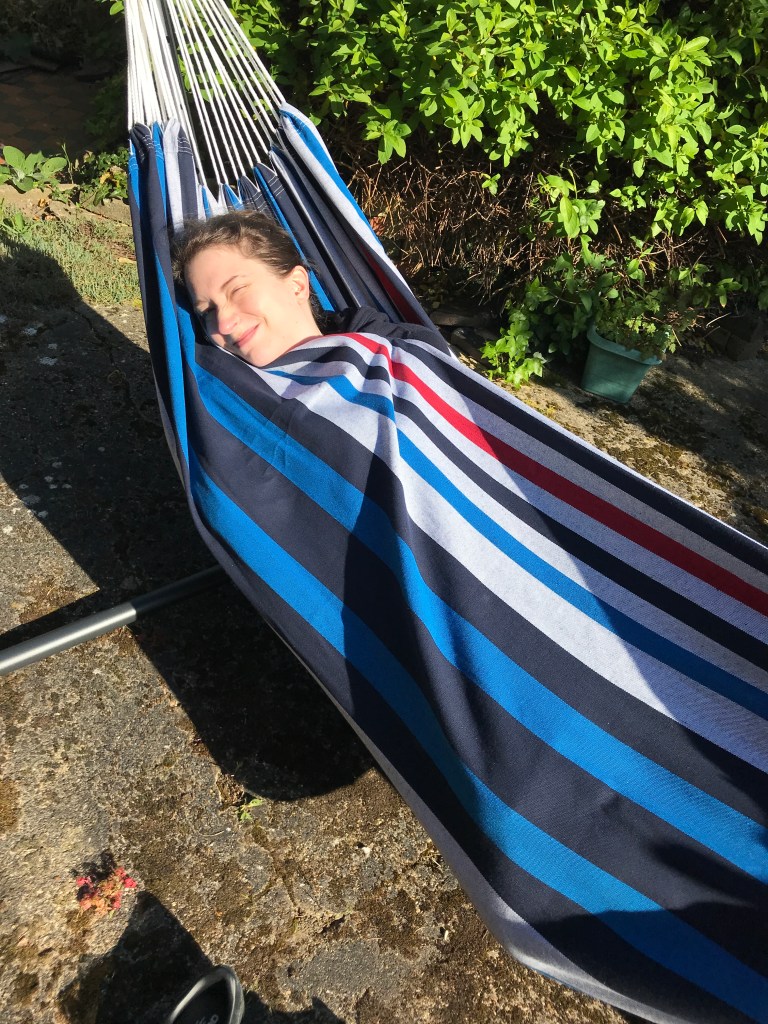
I’m feeling fairly mentally resilient at the moment –  this is a situation that I am not only prepared for, but thrive in. Because of my varying health I tend to only leave the house a few days a week, not usually to socialise, but often just to write, or read newspapers in the coffee shop as I find it easier to concentrate out of the house. Replacing the coffee shop with a Nespresso machine was fairly simple, a bit harder to find my motivation though (more on that in a bit). My quizzing life, too, has been almost seamlessly replaced with an online league via Zoom, which has zero accessibility issues for me unlike most of the venues we quiz in normally. I’ve been out a few times for rolls around the neighbourhood – not “exercise” but arguably good for mental health and vitamin D levels – except the fear of contagion slightly diminishes the mental health aspect, so I have invested in a hammock for the garden so I can enjoy the sunshine secure in my safety.


IMG_4629

A rather nervous roll around the neighbourhood.


Self isolation means a lot of people are spending more time on their own than they ever have before, but for me and Chris, my partner, it’s been a sudden cohabitation simulation! He knew I wouldn’t be able to physically cope on my own for however many months we thought this might last, so just before the lockdown was announced he went back home and packed a bag of clothes, cooking ingredients (yes really!) and his Apple TV plug in. Unlike normal life, where I mostly rely on ready meals, I’ve been having fresh home cooked meals every evening and company for most of my waking hours. I’m so used to being alone for most of the time, it’s both weird and lovely having him here all the time like this.

Lockdown has made me feel a little pressure to *do things* while it’s on, a sort of pretend deadline since I don’t actually have a job or commitments to return to when it’s over. I’m ignoring the existential doom of the latter fact and enjoying having some structure via activities which I will definitely carry over to my normal life: Duolingo (picking up Hebrew again after having to drop out of my postgrad course); planning out short stories  after maybe 10 years since I last wrote fiction; and photography – earlier this week I had an email from the editor of the local independent newspaper asking if I could go and take some shots in my area of pictures and messages of hope people have put up in their windows, which I was more than happy to do. At normal post-work rush hour, the streets were nearly empty of people or traffic, and the air smelled like grass and trees, not of car fumes.

There is a down side to lockdown life, even for quasi-hermits though: everything medical has been pushed back months, if not more. It’s understandable due to the unprecedented situation, but when I’m still having allergic reactions to unknown triggers, and the deteriorating hip situation was only very slightly ameliorated by a new mattress, the fact I likely won’t see either the allergy or pain specialists this year again is frustrating. I’m still talking to my GP about managing the allergies/MCAS?/whatever is going on with that, but still have a whole list of tests at the allergy clinic to get through that can’t be done over the phone. Ditto with finding an effective regimen for breakthrough pain. I have waited years for treatment before though, I can grit my teeth and wait again.
However, one long delay has made me feel rather lucky despite it being a major bugbear for the last few years – housing. Self isolating in my dad’s large, airy ground floor flat with garden access (and, notably, without my dad!) is far easier than I imagine it would be in wherever I move to next, where I don’t expect I will have a garden of my own or anywhere near as much room to temporarily cohabit in. So I guess I can be wryly thankful to the council for their mismanagement of my housing case up until now.

I’ll sign off with this picture of me being a pod-person. I hope you’re all keeping safe and doing okay!

IMG_4735

cosy in my cocoon


Force Majeure

16 Monday Mar 2020

Posted by ninachildish in Blog, health

≈ 2 Comments

Tags

coronavirus, health, pandemic, quarantine

Priorities have changed so quickly in just a few days.
Housing? Not important.
Getting mental health support? Not important.
Attending hospital appointments? Not important.
All that matters is staying healthy and not contracting the virus raging around the globe at the moment. I’ve not had a flu or other major virus since being diagnosed with heart failure in 2018 and I don’t want to put it to the test with something so catastrophic to people with existing heart or lung conditions.

I don’t know when normal life will resume. It’s hard to get my head around the scale of this. It’s unprecedented in my lifetime, my parents’ lifetimes, my grandmother’s lifetime. Friends are losing jobs, businesses will shut down due to lack of customers. People I know are going to die. Everyone will lose loved ones. It still doesn’t feel real.

We’re considering decamping to my grandmother’s for the next whenever because there’s so much more space than in this flat, and if my dad gets ill then my gran can still be looked after without risking bringing in outside help. I’m waiting to hear back from my dad, but my cousin has offered to drive us up to so we don’t have to use public transport. We need to find out whether I can get my prescriptions sent up there or if I’ll have to change GP surgery for the time being first though. No point quarantining to stay healthy if I get ill from not having my meds. I feel so privileged that my partner has offered to stay with me throughout this, even though he could go back to his flat or his family home. It’s a huge sacrifice for him, if he stayed alone he would have far more freedom.

Please stay safe out there (or in there!). Practice social distancing, and good hand hygiene. If you or someone you live with has existing health problems, stay in if possible and limit physical contact with each other if you have had contact with others outside. Keep an eye out for your elderly and vulnerable neighbours. This pandemic has already brought out the worst in people, grabbing supplies from each other and hoarding essentials when some have none – now it needs to bring out the best in us.


The Never-ending Existential Crisis of Chronic Fatigue

31 Friday Jan 2020

Posted by ninachildish in Blog, Disability, health

≈ 7 Comments

Tags

chronic fatigue, chronic illness, ehlers-danlos syndrome, existential crisis, heart failure, managing chronic illness, personal

Excuse the mouthful of a title, I’m too tired to think of a clever one.

I’ve spent most of the last week in bed, alternating between silently cursing at my body, crying self-pityingly into my emotional support plush toys, and (mostly) sleeping. Post-exertion fatigue hit me like a truck after I dared to go out for a moderately ambitious date day on Saturday. Then yesterday the rage and anger finally settled, self care mode switched on, and I made a series of very small, achievable goals – the last of which was to write this blog post, some of which I’ve been meaning to expand on for quite a while.

These fatigue crashes have been more and more severe since 2014. Although I’ve never been “well”, at least since I was in my tweens, I can pinpoint the day Things Got Much Worse. February 14th 2014, the day I moved across London, once again hopping from one parent to the other (somewhat easier when they’re in the same city, let alone the same continent). That move, although aided by my dad and my then-partner, precipitated a catastrophic crash – whether from emotional or physical stress I couldn’t say, but it was this which led a GP to prescribe me painkillers for the first time, and refer me to the UCLH Hypermobility Clinic for assessment and diagnosis. Since then I have lost count of the crashes, but the pattern is always the same: I never quite manage to regain the ground I’ve lost before the next one comes.

Thinking about that, the ground lost and not made up, has made me philosophise this week in between the sleeping and gradually dissipating rage. What am I fighting with myself for? I never had health, I just had a genetically-cursed body trying desperately to keep up with those of its peers, constantly wondering why I found everything so damn difficult when no one else seemed to. I spent 15 years thinking I was just unfit, or that eventually my body and mind would align and reconcile with what was expected of them. I think this could be called internalised ableism, no thanks to the doctors who told me these things. “Everyone gets aches and pains sometimes” turned into honestly believing until I was in my mid-20s that everyone was in pain constantly because that was my reality. From a young age I was constantly trying to attain something that I couldn’t reach, but didn’t know I had no chance of gaining – a body that was not disabled, that did not hurt, that did not inexplicably need so much more rest than others. Similarly, I cannot fight to regain health I didn’t have to begin with. My body does not need me to be angry with it –  that is energy I could be spending elsewhere –  it needs comfort, rest, and patience, no matter how hard it is to give it those things when I feel it is betraying me.

You cannot hate your body into being healthy

Self-care mode involves making aphorisms on design apps.


Of course, reconciliation with an oppositional body is only one aspect. The rage and tears of the last week were not only from frustration with my body, but pent up from years of watching my life pass before my eyes un-lived. I have always been a late starter. I walked very late (although I was a precocious reader, go figure). I did my GCSEs a year late thanks to moving countries. I did my A-Levels in my early 20s, because my late teens were a nightmare, and subsequently started university late. Of course, I also graduated a year after I was supposed to because of my health. I am reconciled with being permanently behind other people in their early 30s; what I struggle with is feeling like all I am doing with my life is sitting and watching the days pass. I used to have dreams I felt I could achieve despite as-yet-unnamed pain and fatigue issues – to travel more, work abroad, continue teaching English, continue with photography on a professional level. I’ve written before about the pain of not even being able to write posts like this one, of the fear that I won’t even be able to connect my random strings of thought together in a meaningful way one day, or any day again. Brain Kittens refers playfully to my legendary distractibility; added fatigue makes the ability to keep a train of thought going far far harder. But even when I have slightly more ability than I do at the moment, I still get a nagging feeling that there’s something more I could be doing right now, something to set myself up for the future, just in case things get better. Just in case. In the last six months I’ve bookmarked disability internship schemes, evening postgrad journalism courses, BSL classes, activism bootcamps, but the reality is the same: I cannot throw money away for something I won’t realistically be able to manage, or that I would make myself seriously ill attempting to keep up with. When I can reliably get somewhere once a week, when I can make all my medical appointments in a month, when I can go out two, even three, days in a row without having to rest at home for a week afterwards, that is when I can look at these exciting things.

The truth is, though, I don’t know if I will ever get to that point. I’m waiting for a miracle that might not happen. However nauseatingly positive* it sounds, to avoid falling into complete existential despair, I have to cling onto that little shred of hope that one day things might get better. That one day I will be – just a bit, but enough – better.


[*Nothing wrong with being positive, of course, but I’m snarking mildly at the ill-girl tropes here.]

the intersection

22 Monday Jul 2019

Posted by ninachildish in Activism, Blog, Disability, health, Mental Health, Uncategorized

≈ 3 Comments

Tags

chronic fatigue, chronic illness, depression, personal, self worth, writing

I’ve spent the last few years insisting that my worsening physical health isn’t impacting on my mental health; that maybe occasionally my brain will mistake not leaving the house for days at a time for depression and slump accordingly; that I don’t grieve for the abilities I’ve lost. I find denial a powerful coping mechanism, but one that only lasts so long.

It’s not that I never get a bit sad about losing my physical abilities. The other night I dreamt I had learned how to click my heels in midair (apparently it was to do with having the right – possibly magic – shoes), and woke up feeling rather wistful, despite not having been to a dance lesson in years . Social media constantly throws up reminders for me of what I used to be able to do – climb a mountain, walk a marathon, stay out all night, walk to the end of the road unaided… I tend to view these prior accomplishments without sorrow; I’m just pleased that I did them while I was still able to. Of course, if I’d known that everything would go so, so wrong before I hit 30, then I like to think I would have done a lot more. For five years in my adolescence I lived on a lake, and can count the number of times I took the canoe out on my fingers. As much as I wish I could go back in time and shake up my sulky 13 year old self into going outside on a bright spring day, instead of spending the day lounging on the sofa with a book, I know that it won’t change the now. At least I have done things, I think. At least I’ve been to places that I couldn’t manage now. I just wish I’d done a little bit more.

But it’s not the physical loss I struggle with. Whether as a result of fatigue, brain fog, lack of ADHD meds or a combination of the three, my ability to sit down and write something longer and more convoluted than a tweet has all but disappeared over the last year. I feel like I’ve hardly done anything in the realm of activism or awareness so far this year – which is slightly unfair as I did write one article and collaborate on another, but it’s hardly the height of productivity. Almost six months characterised by notebook pages and blog drafts with ideas, starts, first paragraphs – and no energy or drive to continue with them.

I have always put more value in my intellectual abilities than my physical ones. As a clumsy, easily-injured child it made sense. Not that I was particularly good at school either. My parents pushed me to work hard (I didn’t) and get good grades (ditto) and I’d throw myself into things that I liked and do the bare minimum with those I didn’t. This is what’s so distressing – I can’t throw myself into my passions as readily as I used to be able to. Thinking through fog I can get a few sentences down, then when I come back to it a few days later or when I’m next able to, the flow is gone. Writing my way through chronic illness and disability has been an invaluable outlet in the last 5 years, and has led to some amazing opportunities, and without it I feel utterly useless, my power centre taken away, my saving grace gone. My self worth is so tied up in my productivity, even my adjusted-for-illness productivity that without having something to be working on, no matter how small, I feel like I have no purpose.

The fog has lifted slightly today, so I’m taking the opportunity to get this down before I lose my train of thought or get too tired. I need to write more, I know this, and write more without worrying about form, readability, coherence. The important thing is that I do write my experiences down, not how well written they are. It’s another mental block to get past.


Diagnostic Curveballs

26 Thursday Apr 2018

Posted by ninachildish in Blog, health

≈ 2 Comments

Tags

chronic illness, diagnosis, health, heart failure, personal, rant, self pity, sleep apnea

Maybe it’s because when I have discussions about diagnoses it’s usually with other members of the chronic illness community, but I’ve been equating diagnosis with answers for a long time. I’m used to posts where people are grateful, relieved to have a diagnosis of a chronic illness. To be honest, so was I – they gave me answers to symptoms that had been plaguing me since childhood. “You have asthma”; Oh, that’s why I can’t breathe deeply without coughing. “You have Ehlers-Danlos Syndrome”; Ah, that would explain the constant pain and loose joints. “You have POTS”; Yeah, I’d figured that one out too due to the tachycardia when I stand up. But not all diagnoses are answers to puzzles, but puzzles themselves – as I am finding out.

Dear body, please stop.

2018 has been a ridiculous ride of hospitals and new things turning up so far, mostly within a 10 week period. With housing stress and overwhelming anxiety being my baseline this isn’t ideal, but I thought I was coping until a week or so ago. Being diagnosed with heart failure at 32 was a bit of a shock but the fog quickly cleared and I realised it didn’t really change anything except how I viewed my body’s need for rest and recovery (in a more sympathetic light, by the way – I struggled before with the psychological need to “shake off” the fatigue, especially when confronted with articles about other EDS patients who ran marathons or “didn’t let their condition stop them”). You can’t really argue with heart failure. Even I, who likes to argue with everything and everyone, am trying my hardest not to argue with it.

Can’t we have a one-in-one-out policy?

Then came the Central Sleep Apnea, which was more of a surprise. I did a sleep study in November and the results were revealed to me earlier this month. I guessed I had some degree of Obstructive Sleep Apnea, and was prepared to be told to lose a little weight, or to see about getting my adenoids out or something but no – it’s my brain failing to do its basic job of keeping me breathing. *facade drops slightly* Stupid body, stupid brain, why is so much going on at once? Oh well, CPAP therapy trial coming up, hopefully that will improve my fatigue by a fraction…

*MARCHING BAND INTERRUPTS TRAIN OF POSITIVITY TO DELIVER MORE TEST RESULTS*

Oh good, more unwanted news. My prolactin levels are approximately 25 times higher than they should be, which was unexpected considering the lack of symptoms (aside from the occasional uh, leaky boob). High prolactin levels can be caused by stress, a side effect of medications (notably older generation anti-psychotics), or a small brain tumour in the pituitary gland called a Prolactinoma. My GP suspects the latter due to the high levels of prolactin, and the fact I don’t take regular prolactin-increasing medications. There will be a scan soon, with an urgent request sent by my GP, then whatever treatment follows. Whatever it is, I need to get my levels down as prolactin levels that high can cause a loss of bone density which I’m already susceptible to. I’m not overly alarmed, but I am weary of my body ramping up its trickery.

And I’m annoyed. Very, very annoyed. It’s just too much now. My diagnosis list reads like someone typed “fatigue” into Google and wrote down all the causes. It’s getting to the point where I’m scared to talk openly about my health because it’s just so ridiculously hyperbolic at the moment and I don’t want to start causing eye-rolls and “oh great, Nina is talking about their health issues again” with every additional, bloody stupid, and unconnected diagnosis. It’s just more questions (“is this obscure co-morbid condition causing Central Sleep Apnea?” “is taking an anti-emetic every week or so enough to ramp up my prolactin levels?”), when what I’m used to getting from a diagnosis is answers. I feel like I need a chart on my wall like in dramas about over-involved investigative journalists, with each condition and symptom connected by coloured yarn, in order to keep track of what’s going on. And this is on top of the ever-present housing stress. No wonder I have trouble getting to sleep.

Thanks for letting me get that off my chest. Normal service will resume soon.


Further Adventures in Bureaucratic Incompetence.

10 Tuesday Apr 2018

Posted by ninachildish in Blog, Disability, Housing, Mental Health

≈ 1 Comment

Tags

anxiety, chronic fatigue, council, depression, Housing, incompetence, Mental Health, personal

Will I ever share good news to do with housing? Well, one day I hope to but today is not that day. When you’re dealing with a department as shambolic, uncommunicative and Kafkaesque as the council’s housing department, you have to cross your fingers and pray that all other agencies involved are on the ball. That appears not to have happened.

This afternoon I spent 40 minutes in an airless back office that smelt of feet, waiting for the results of the Great Bureaucratic Incompetence-Off. I knew that the council had sent a form (plus a freepost envelope!) to my GP back in October – I knew this because it had been put into the system shortly before I had an appointment in November, and the GP I saw had told me her colleague would be doing it soon. I also knew that it was now five and a half months later, and I had seen zero progress as far as housing went – but also that sometimes the council needed something akin to 20,000 volts up the arse to do anything with the information they themselves had requested. However, an afternoon at the housing office is only slightly more preferable to one spent having a filling without anaesthetic, and I assumed that finding anything out from the GP’s office would be somewhat easier than dealing with staff at the housing office (you know those characters in videogames who have important things to say to you but you can’t ever work out the right thing to make them say it?). I guess in retrospect 40 minutes in an eau-de-pied office surrounded by broken blood pressure machines was better than [time doesn’t actually exist in a housing office] the alternative.

“There’s a queue, dear”, said the receptionist, when I asked her to look up the letter on the system, and see if anyone had “actioned” it (arrgh, not a verb, I refuse to accept it).
I was aware there was a queue, I had waited in it for 10 minutes, and now I was at the front of it. “Can’t you come back another time?” Mindful of the ‘aggression will not be tolerated’ rules laid out on laminated pages on the counter, I aimed for ‘snippy but polite’ and pointed out that there was always a queue and by the standards of queues I’d been in there, this was quite a mild one. Five minutes later I found myself guided to the back office by the reception manager, and left for 20 minutes or so while she tried to find out some more information. She returned holding the sheaf of printouts that the first receptionist had handed to me 20 minutes ago. No, nothing had been done with the forms since they arrived in October. For over five months I sat at home like a lemon (again!) assuming someone was doing something with the information I had given them (again!) but instead the Thing That Needed Actioning (argh!) was sitting in a to-do pile in another dimension (again!)*. She left again for a while, and came back to offer me an appointment to fill the form out tomorrow morning with, awkwardly, the same GP who told me that her colleague would be doing the form five months ago.

(*) If this sounds depressingly familiar, it’s because it is. From January til June 2017 my housing application for impending homelessness sat in an unattended inbox until my friend (who is a housing support worker, but not for my council) badgered them into finding it and starting the process. So that makes a grand total of 11 and a half months of unnecessary delay out of the 15 months since I submitted my application to the council. Should I have sat around for both delays, waiting for them to get this far without chasing anyone up? Of course not! – and that’s where the paralysing anxiety comes in, and the depression that makes me too miserable to even think about housing, and the fatigue that prevents me from being in any way useful most of my waking hours. Basically, all the things that will go on that medical form tomorrow. It took until today for me to feel okay enough to ask about the letter; it’s nearing a miracle I still have the energy to write about it after.

THIS is why I need an advocate, a support worker, a someone who can do the chasing-up and checking-in. It’s not me trying to shirk responsibility for my own endeavours, but trying to ensure that I don’t fall between the cracks again. Because I have, due to the aforementioned assortment of brain kittens and body woes. When I do speak to people about it, their assumption is often that I’m trying to weasel out of doing my own work; I’m educated, well spoken, on paper I should have my shit together. In reality, I’m holding the cracks together with jam. However, I have a vague plan: tomorrow I see the GP to do the form and at the same time I will ask if she can refer me to somewhere. If I have no luck there, I see my therapist on Thursday. If no luck again, the CAB (so, somewhere around 2019 when I’ve built myself up to it….)

I’d just really love for every step in this torturous process not to come with its own obstacles. NOTHING about the housing process so far has been anything less than frustrating. At this point, “frustrating” would be a vast improvement.

← Older posts

Support me on Ko-Fi

Buy Me a Coffee at ko-fi.com

search the blog

Categories

Recent Posts

  • Access Review: Donmar Warehouse
  • Being the football.
  • The Medication Postcode Lottery
  • The Accessible Home Project pt1: The Stairlift
  • burning

Tags

ableism access accessibility Accessible London access review Activism aids and adaptations anorexia anxiety beauty benefits borderline personality disorder bus buying tickets campaigning chronic fatigue chronic illness CMHT complaint coronavirus council crip the vote depression diagnosis disability disability services DWP eating disorder ehlers-danlos syndrome ESA eviction Family fuck tropes general election gp Hamilton health heart failure Housing hypomania incompetence London managing chronic illness Mental Health Mental Health Awareness Week mental health services microaggressions money policing mother news New Year's Resolutions nightmare personal pip poetry positivity powerchair privilege product design product review rant recovery relationship self pity shopping sleep apnea social anxiety suing a bus company theatre therapy Tories transport wheelchair wheelchair access work capability assessment

Website Powered by WordPress.com.

Privacy & Cookies: This site uses cookies. By continuing to use this website, you agree to their use.
To find out more, including how to control cookies, see here: Cookie Policy
  • Subscribe Subscribed
    • Nina Childish
    • Join 133 other subscribers
    • Already have a WordPress.com account? Log in now.
    • Nina Childish
    • Subscribe Subscribed
    • Sign up
    • Log in
    • Report this content
    • View site in Reader
    • Manage subscriptions
    • Collapse this bar
 

Loading Comments...