• About Me
  • Contact
  • Links to other stuff I’ve written
  • Useful Links

Nina Childish

~ and various brain kittens

Nina Childish

Tag Archives: access

Why Are Bus Companies Still Discriminating Against Wheelchair Users?

23 Monday Feb 2026

Posted by ninachildish in access, Disability, Travel

≈ Leave a comment

Tags

access, bus, buses, disability, disability rights, London, transport, Travel, writing

At the start of the year I was dismayed yet unsurprised to find an article on the BBC News website stating that the rights of wheelchair users to use their assigned space on the bus is still not being enforced by bus companies, against TFL guidelines for their various providers of bus services, which states they must try and assist (which includes actions up to and including stalling the bus then waiting for people to make space). Driver resistance to helping us access the wheelchair space seems to be the norm, not the exception in my decade as a wheelchair user in London, especially in the area which I used to live and from the bus company which operates there. I’ve written about this topic numerous times, and even successfully claimed against that specific bus company on two occasions. My claims against Arriva North London were settled in 2020 and 2023, but nothing seems to have changed, hence my dismay. For a short while I felt like things might be improving – there was a period in late 2019/early 2020 where I noticed drivers on my frequent routes were more helpful when asked to intervene, but this ended with lockdown. It was like they forgot disabled passengers existed at all after we weren’t able to travel for most of a year and were then inconvenienced by our return. I moved out of London a couple of years ago, but when I’m back visiting and trying to get to the tube station from my dad’s, the drivers on that exact route still try to shrug off their responsibility, which combined with the attitude from Arriva during our many discussions explains my lack of surprise at the BBC report. I’ve not written a lot about the actual cases against Arriva, mostly because life (Covid, house move, brainfog) got in the way, but I will detail a few things here about the attitude of the higher-ups in the company and why I believe things will not get better for wheelchair users of their bus routes until this changes.

Almost immediately I was told pretty much verbatim “we can’t do anything about the drivers” as if they were in an ironclad union running separately to the company that trained and employed them. One manager said that if he fired a driver, even for repeatedly discriminating against wheelchair users, that driver would be able to walk right into another bus driving job no questions asked, “so what’s the point?”. This left me rather gobsmacked – it sounded like the company was saying the drivers were untouchable, untrainable, and not their responsbility. But I didn’t want anyone sacked in any case, just to do their job as laid out in the Red Book (TFL bus driver manual). My solicitor and I tried to nail down one condition of settling as a commitment to adequate training, Arriva North London being one of the few TFL subcontractors which doesn’t have user-led training – i.e. a real life disabled person talking to trainee drivers about the necessity of public transport, access and how dehumanising it feels when a driver doesn’t even let you ask people to make space and drives off without you. (It feels incredibly dehumanising, as I think you can guess. It feels like I am optional, lesser, an unwanted hassle.) Again, we were shot down. “We can’t pull drivers out of work to give them extra training”. Well, that’s not what we were asking, but they could try and train them fully in the first place, to the same industry standards as most other transport companies do. This was also dismissed as being too expensive and I ended up being offered a nice shiny carrot in the form of a starring role in a video about wheelchair access to buses, potentially to be shown in training. It’d probably be very like what they already have – nothing is as effective as user-led training – and apparently Arriva North London would rather continually pay out to disabled passengers who have been discriminated against and back up their drivers, even those that repeatedly break the rules, than try to ensure a good reputation via stellar training. I know many people aren’t in the position to give time and energy over to making a claim against a large company with lawyers on retainer, but I believe if more of us did this then they would eventually start to budge. (Also no one ever contacted me about that video.)

But what of now? Well, I’ve not made a complaint against a bus company since 2023*. And why is that? We moved to Norwich in the summer of 2023, and in that time I have had zero problems with the bus companies that run here (although I’m not counting issues with rail replacement buses – that’s for another day!). I don’t take the bus quite as often as I did in London, because it’s a much smaller city and on a nice day I can get to anywhere I need to in the city without having to use public transport, but I still use it relatively frequently and have never yet encountered an issue like the ones I had with Arriva. In fact, the only problems I’ve had with buses since moving have been when back in London to visit! So how it is that buses in this small city of ~200,000 people are so much better for wheelchair users than those in a metropolis of 15 million?

The first reason is based on bus design. The double-decker buses here have a space for a wheelchair user and a separate one for buggies. Both areas have fold down seats which passengers can use, but they have to move when the spaces are needed. I have missed a bus before because there was already a wheelchair user on it (no issue!), and in peak times, especially because my nearest stop is on a university route, sometimes the bus is just packed full and I can’t get on – but neither can anyone else so it doesn’t feel like I’m being singled out for being a wheelchair user! The other reason is that the ramps are still manual fold-out ramps, the kind the driver has to get out of their cab to open and close. They’re not hi-tech like the computer-controlled ones in London, but I’ve also never had one go wrong, get stuck, refuse to deploy or leave me stuck on a bus for 2 hours while we wait for an engineer to be free to come with the tool that can manually crank it open. There is another post to come about the issues with those electronic ramps, I can feel it brewing.

So what to do about the ongoing issues in London? I wish more disabled passengers felt able to put in claims with teeth against bus companies that discriminate. If anyone does want to know more about doing this, feel free to get in touch via email or comment and I can give you some pointers. We need to keep lobbying for the right to use the wheelchair space as wheelchair users, lobbying for user-led training and for real action to be taken when we are denied access instead of endless meaningless apologies. Above all, don’t shy away from taking public transport because of a fear of conflict. The more we are out there living our day-to-day lives, the more people will realise that disabled people are a part of this society whose inclusion deserves to be accommodated.

* A little primer on my complaint protocol: Not all Bus Issues result in an official complaint being made, which some people might disagree with, but I have to pick my battles. I only complain if it ends with the bus leaving without me. If the driver refuses to assist or initially says I can’t board but lets me ask people to make space myself, then I’ll let it go. Thanks to experience, I now always email for the CCTV from the bus, and explain that I have done this in my complaint. Without it there would be no proof to back up my claims, and though I do sometimes record video myself that can be viewed as confrontational and detrimental to my aim of actually getting on the bus.
Access Review – London Palladium

19 Sunday Feb 2023

Posted by ninachildish in access, Accessible London, Reviews

≈ Leave a comment

Tags

access, access review, Accessible London, London, London Palladium, wheelchair access

Danger: May contain accordions.

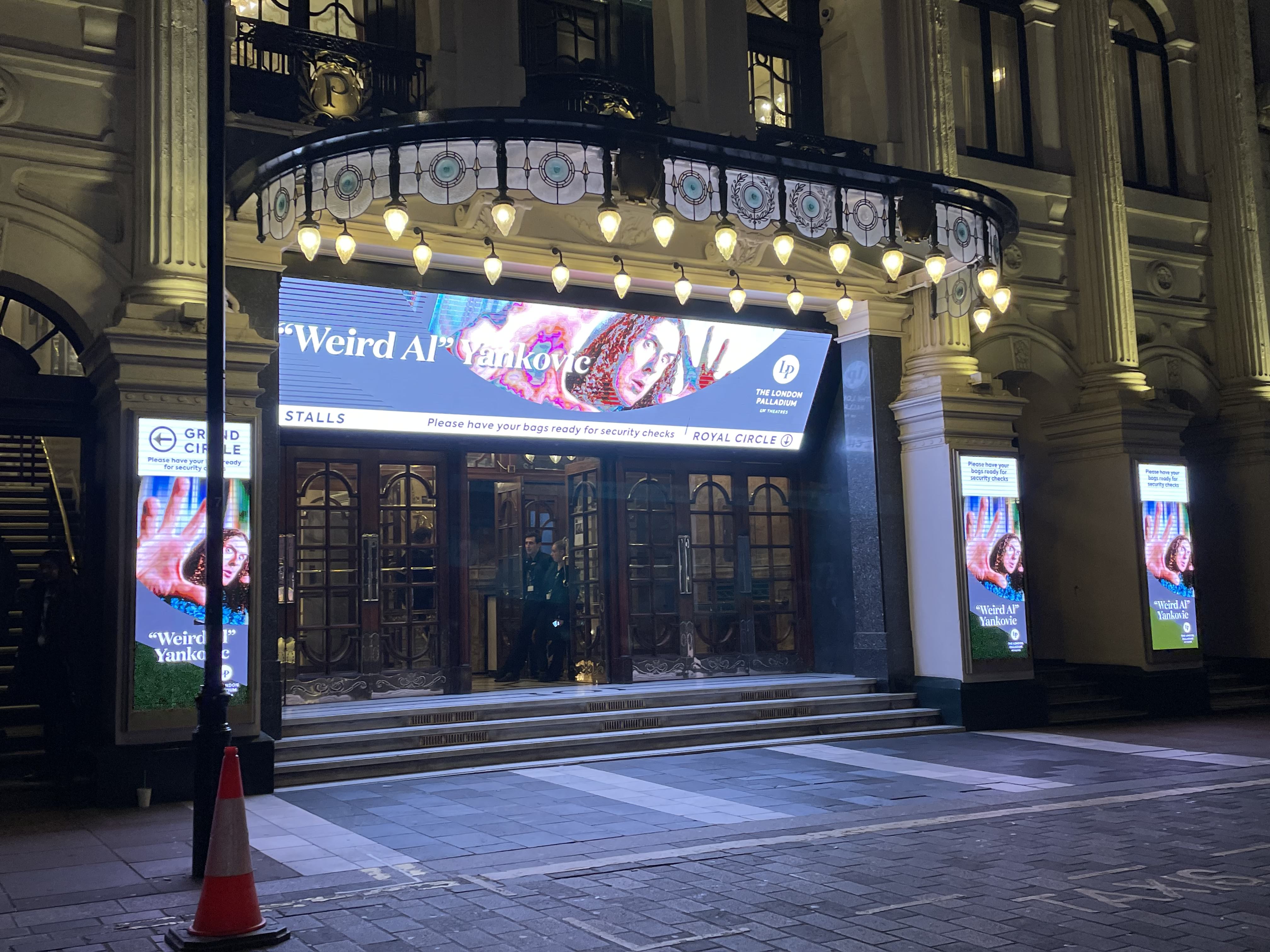
The London Palladium is one of the capital’s most celebrated theatres, having hosted shows and revues since 1910. It has just under 3,000 seats and a few wheelchair spaces. We visited earlier this week to see Weird Al Yankovic – I will not accept any shaming! – and I realised that this must be the first time I’ve actually been there since I was about 9 when my dad took me to see the celebrated revivial of Oliver! (which I now know starred Jonathan Pryce as Fagin – no wonder my dad wanted to see it!). I am familiar with Argyll Street, though, having spent many Friday evenings as a teenager rushing there as soon as I could after school to purchase tickets (in person! with cash!) from Stargreen’s box office for gigs in far less fancy venues. I have some surprising nostalgia for those years, when I didn’t worry about access issues and when £30 was considered a bit steep for a concert. When, as my erudite Welsh friend puts it, I’d throw myself into mosh pits full of 6ft+ metalheads “like f**kin Bambi on ice” despite being about as sturdy as a matchstick model held together with bubblegum. Considering it turns out that I do basically have bubblegum for connective tissue I’m amazed I never ended one of those nights in hospital, but I did come home with my fair share of giant bruises. Back then I could never have imagined going to a gig without standing/dancing/pummelling the hell out of a stranger then sharing a beer with them. I digress, but it’s amazing what I remembered as we turned into Argyll Street. Now back to our regularly scheduled review:

Getting Tickets

The Palladium is a member of the LW Theatre Group, whose access scheme allows members to book online and to book tickets over the phone without having to send proof of eligibility for wheelchair space or companion tickets every time. However, I chose to phone them for this event and there was no problem processing my order or adding the extra ticket.

Getting There

This is far easier than it used to be thanks to the fully accessible Elizabeth Line! Before it came along, if I wanted to go anywhere in the Soho, or Mayfair areas I would have to go to Green Park and go on the pavements through tourist hell from there. Taking the Elizabeth Line to Bond Street brought us out just a 3 minute roll from the theatre which was perfect.

Entrance

Next to the steps to the grand circle outside the theatre (so to the left of the image above) is a gently sloped passage where a member of staff took us through into the theatre. From there we were met by a dedicated access staff member who took us in a lift to the level of the bar and our booked space. The lift is quite small, but I was able to fit in with my midsized powerchair, my partner, and the staff member. The bar is accessible but doesn’t have a lowered area. The merchandise stand was also in this area. To get to the doors into the theatre itself there was a curving ramp integrated in next to the stairs where the access staff member was waiting for guests using wheelchairs and other mobility aids.

Wheelchair Space

The route to the wheelchair space itself and the distance between the spaces and the accessible toilet is the only negative I can find with the Palladium’s access but there is a good reason for it. We entered during the break after the support act, and the access staff took us across the back of the theatre, around a rather steep corner (it was a struggle to keep all wheels on the ground!), then down along the sides of the stalls seating. As you can imagine, this included quite a lot of “excuse me please” and “mind your feet!” because there wasn’t a lot of space for people to move out of the way. The spaces were right at the front on the ends of rows A and B, and occupied by myself and a young man in another powerchair. Because of the way the spaces were so close, if I’d needed to leave for any reasons he would have had to move out into the aisle too and it would have been quite… beepy. I can’t fault the Palladium, though. The access staff member told me that they used to have the wheelchair spaces at the back row of the stalls both to avoid the issues getting down the aisle and also to keep proximity to the accessible loo, but while this works well for the pantomime, it doesn’t work quite so well for concerts where audiences often stand up and dance/cheer and block all view for the people in the back who can’t stand up! (I remember this problem from Father John Misty at the Barbican, but luckily that was only during the last song!) We were also positioned right next to a speaker, which didn’t impede our view but did make it quite an overly loud experience in my right ear. I’m not sure if the sound system was set up specifically for that one show, though.

Services

It’s always appreciated when theatres have dedicated access staff, and it’s easy to tell when they are proper Dedicated Access Staff and not “the staff member who was put on wheelchair duty that day”. I can’t fault them at all. There was a queue for the loo afterwards and one of the staff was telling us how she was now a mental health first aider, and how she sometimes had to take overstimulated kids out of the seats to decompress, hand out ear defenders, or let off steam by dancing or stimming at the back of the theatre. It was lovely to hear that it’s not just physical disability that is treated well at the Palladium and we were very impressed with the staff there.

Toilets

There is one accessible loo at the Palladium, located through a door next to the entrance into the stalls. The vestibule which it is in also holds transport wheelchairs, walkers etc. belong to patrons who can transfer into theatre seats or collect their mobility aids after the show. The loo itself is an impressive size for a West End theatre – I was able to turn my wheelchair around to leave instead of reversing out by ramming the door – however there is no room for side transferring due to placement of bins. There is a large grab-handle on the door to close it, but the lock is a small turning one which might be a problem for someone with grip difficulties.

Overall I was pleasantly surprised and impressed. My experience of West End theatres since using a wheelchair has ranged from difficult to very difficult on the whole, and it’s great that the Palladium is bucking the trend. All the great staff in the world can’t make up for poor access, but the Palladium wins on both counts.

and now:

Equal Access Booking: Good Venues in London

19 Monday Dec 2022

Posted by ninachildish in access, Accessible London, Disability, Reviews, Uncategorized

≈ Leave a comment

Tags

access, accessibility, Accessible London, buying tickets, disability, London, theatre

Although I review individual venues, including the booking process, I thought it would be useful to keep a list of venues (London-based for now, as that’s where I go to the majority of events) which have easy booking for disabled customers. By that, I mean being able to book online without the extra hassle of having to call or email to ask for tickets, like every other person gets to do. Some of these venues only allow online bookings if the customer is a member of their access scheme (which are always free, and remove the need to constantly provide proof of disability) and I have pointed out where these are applicable. I am focussing on the provision for wheelchair users specifically, as this is my own experience. Do please let me know if I’ve missed any venues out!

Barbican

The Barbican operates a good access scheme, and has obviously put a lot of thought into making a visit to their City Of London home a less stressful experience for disabled people. While anyone can buy wheelchair space tickets online, access scheme members will automatically have the cost of a companion seat discounted when added to their basket. Blue Badge holders can also reserve a parking space for the time of their visit up to three months in advance.

The Bridge Theatre

Sign up to access list to book online (more info to come)

Donmar Warehouse

Sign up to access list to book online (more info to come)

National Theatre

Actually a complex of three theatres – the main Olivier, and smaller Lyttleton and Dorfman theatres – the National Theatre has an access scheme that doesn’t require much personal information to join, and is more interested in the applicant’s access needs. After joining, logging in to the website allows disabled people to book both wheelchair spaces and companion seats online with no follow up needed. However in my personal experience, despite being signed up to the access list, I can only book the wheelchair spaces online for the main Olivier theatre. Booking for the other two theatres requires phoning their dedicated access line on 0207 452 3961 (11am-6pm Mon-Sat).

Roundhouse

Camden’s impressive 1,700 capacity venue is equally impressive in its provision for disabled patrons. There’s no coincidence that of the ten shows I currently have tickets for, 70% are playing here. The Roundhouse does not have an access list, instead asking ticket buyers to confirm that a member of their party has access requirements before purchasing and has a text box for additional information if applicable. This is followed up with a polite email confirming that a wheelchair space (which comes with a free companion ticket in all cases) has been purchased. In a nutshell, the venue is trusting people not to take advantage of something that is not meant for them. And it seems to be working.

Soho Theatre

Located on Dean Street in the heart of London’s historic Soho, the building is commendably accessible for its cosy space. To purchase access tickets for events Downstairs or for the Theatre without having to call the box office you must have an account on the website. After purchase, the box office will get in touch to ask if you require a seat removed for a wheelchair or if you will be transferring into the seat. They also ask you to please email with your booking reference for a free companion ticket if required. Upstairs is a smaller venue without reserved seating, and while you can buy Access tickets online, this should be followed up with an email specifying if you’ll be needing a space for a wheelchair, and for a companion ticket if needed.

Southbank Centre

This brutalist complex is one of the most accessible venues in London, and a frequent host of disabled performers too. Buying wheelchair space tickets for events at the Southbank Centre is done after simple application to their access scheme, where preferences/needs can be toggled as seen below. Wheelchair spaces then appear on the ticket seats map, and customers have a choice of either a single concession ticket, or a concession ticket and heavily discounted companion ticket combo. When viewing the basket, a notice appears reminding customers that the ticket they are buying can accommodate a wheelchair user only.

WTF ATG? (now updated)

06 Monday Dec 2021

Posted by ninachildish in access, Activism, Disability

≈ 1 Comment

Tags

access, Ambassadors Theatre Group, buying tickets, customer service, disability, theatre, wheelchair

New lows in access bookings.

No “sorry for being so irregular at updating this” preface this time, let’s just jump right in.

We are trying to buy theatre tickets, specifically to Cabaret at the Playhouse in London’s West End. We love the theatre, and go multiple times a year (when pandemic conditions allow). This year we’ve been to the National Theatre to see Under Milk Wood in July, and last week went to Alexandra Palace Theatre for Mark Gatiss’s A Christmas Carol (also an excellent example of how to do disability representation on stage, btw!). For the National Theatre we had to call, but they answered very quickly and sorted us out, and for the Alexandra Palace Theatre I emailed customer services there who sent my details onto the ticketing agent who, again, got me set up with tickets very quickly and efficiently.

And then there’s the Ambassador’s Theatre Group (ATG), of which the Playhouse is one. They deal with all online and access ticketing for their theatres. And boy, do they do it badly.

C emailed their customer services about access tickets 10 days ago, as there is no special email for this need, with the aim of surprising me with tickets to Cabaret as he knows it’s one of my favourite shows, if not the favourite. However, five days ago he decided to tell me he’d tried this because the only response he had back was an email stating it could take up to fifteen days to get a reply (let alone complete the booking!) and, because going to the show is more important than the surprise, I said I’d start calling to increase our chances of getting to see it. I don’t think, however, that the collective 90+ minutes I’ve spent on hold since then have helped us any. The access line promoted on the website is no longer in use, and the one we’re told to call instead has no listed operating hours. Combine that with no queue system on the phone line itself which tells you how many customers are in front of you, I was left with the idea that I was hanging on for an unattended line in an empty office.

With the days going by, and the tickets unsurprisingly flying out of the box office, I sent another email today pointing out the extreme discrepancies between our experience so far and the one a non-disabled patron would enjoy (*click* *click* *type in card details* *done*). It’s since been forwarded to “the appropriate team” but the quick reply (as they will reply quickly when you mention breaching the EA2010) obviously had to mention the fact that the general customer service line was also very busy. Which is utterly beside the point, because I’m only trying to book tickets. That which the average patron can do in under a minute has taken us over ten days so far.

Money might make the world go around, but to get tickets you need full health too.

I didn’t think anything could be worse about West End theatres than the endemic accessibility issues we have to suffer in the listed-building theatres (see a myriad of now-fixed issues here). It turns out ATG’s accessibility service is threatening that crown! Through thorough perusal of their confusing website, we’ve learned that every ATG theatre has an “Access Champion” which makes me wonder why on earth their customer service to disabled patrons is still so appalling. I’m going to send a (far friendlier) email to the attached “champion” of the Playhouse theatre to see if that helps matters in this instance, but this is about far more than me getting tickets to the show I want to see. This is about making a fairer and more equitable system for disabled people to access the arts, company by company. We might not be able to change the access in the venues, but there is no excuse for such shoddy access ticketing.

UPDATE (shamefully late):
So, after posting this blog I sent a Polite But Scathing Email © to the “access champion” address listed on the ATG website. Someone replied quickly and after explaining my problem he gave me a mobile number to call the box office directly to purchase tickets he’d reserved for me in the meantime (which took a further three days as the line was only operating on limited hours). I was able to sort out tickets for a show in the middle of January a whole 16 days after first trying to get them myself. (They finally replied to my partner’s initial email to the access inbox 5 weeks after he sent it!) The silver lining was that the only wheelchair accessible spaces are at the very front of the table seating and at a fraction of the eye-watering price. My experience has been fed back to ATG’s access coordinator and I hope it helps to improve things for wheelchair users and others who need access tickets – please let me know if you’ve had good or bad experiences with them!

My review of the Playhouse-turned-Kit Kat Club is here. 

Access Review: National Theatre/Lyttleton Theatre

22 Sunday Sep 2019

Posted by ninachildish in access, Accessible London, Disability, Reviews

≈ Leave a comment

Tags

access, access review, accessibility, Accessible London, London, theatre, wheelchair

It’s been quite a while since I’ve done an access review, but since I’ve been to the theatre a few times recently I thought I’d dig into my notes and do another one. After all, this was what my abandoned blog and remaining Facebook page are concerned with (I was overwhelmed juggling two blogs and a FB page, so decided to write the reviews here and crosspost to the FB page!)

I took my dad to see Rutherford & Son at the Lyttleton Theatre, part of the National Theatre complex on the Southbank at the start of August. As with most access reviews, there’s good and bad stuff in here that I hope you will find helpful!

Getting Tickets

Lets get the bad news out of the way first, the National Theatre is one of those theatres that wants disabled patrons to sign up to an access list first before they are able to book tickets. However, unlike many of these schemes, they do not require an overly intrusive “proof of disability” such as scans of PIP letters or blue badges which was appreciated. They ask about specific needs, which include aisle seat, wheelchair space, audio description or captioning. After getting confirmation that my access list application had been received and filed, I could book the wheelchair space and companion tickets on the website, which was also greatly appreciated. There’s nothing more galling than having to phone to book access tickets as the only option, only to have 20 minutes of hold message telling you how much easier booking online is.


Entrance

Perfect. Being a large complex of three theatres next to the wonderfully accessible Southbank Centre and BFI, the National Theatre has full wheelchair access. No platform lifts, no precarious ramps. Entrance to the Lyttleton Theatre was well signposted, and while a good portion of the audience headed for the stairs or the lift, we were shown to a door in the wall which led to the wheelchair space at the top of the stalls seating. And here I found the only problem…


Wheelchair Space

With four spaces available, the Lyttleton Theatre has more wheelchair spaces than the average London theatre, where sometimes there are only one or two for a capacity of hundreds. All of these spaces are in Row V, at the back of the stalls where the view is still acceptable. However, something was missing in Row V – the companion seat!

IMG_3496


Those are my pixie boots, and just in front and to the left of them is my dad’s seat, in the next row down. The purpose of  a companion ticket is to support the disabled person if necessary. If I had needed help during the performance, like needing to leave to go to the toilet, or help with emergency medication, it would have been disruptive for the rest of the patrons as my assistance wouldn’t be right next to me and I’d have had to adjust my wheelchair (beeping, whirring) to reach him! Also it did make for quite an isolating theatre experience being up on my own next to the sound desk!

If someone with far greater needs than myself (such as needing assistance with drinking) were put in this wheelchair space, then there is no way their companion would be able to take the booked companion seat, and I wonder what would happen then?

Services

No complaints here either. The atrium of the Lyttleton Theatre is in the wider National Theatre lobby, and the bar and café are on the same level as the entrance and level-access door to the theatre.

Toilets

Fine – roomy, red cord dangling as it should be, no nappy bins blocking access. Though it should be noted that the toilets (including the wheelchair accessible one) are located in the main foyer of the National Theatre, and any members of the public can come in and use them so you may find yourself waiting if a passing wheelchair user gets caught short!


Overall, because it’s part of the larger National Theatre complex, the Lyttleton Theatre is very good for access – notably when it comes to booking tickets and getting around the building. The only way it let itself down was the set up of the wheelchair space and companion seating, which should be an easy enough fix. As always, I will update if I hear anything back from the theatre or someone else visits and gives me news of positive change!


Disabled facilities are not storage spaces.

14 Saturday Apr 2018

Posted by ninachildish in access, Activism, Disability

≈ 4 Comments

Tags

access, accessibility, disability, rant, shopping, wheelchair

“Disabled facilities are not storage spaces.”

You’d think the above statement would be obvious. After all, what use is a cubicle or toilet if it can’t be used for its intended purpose? Unfortunately, the answer is often found inside – where these facilities created to enable wheelchair users to try on clothes or use public conveniences are misappropriated as store cupboards.

I cannot tell you the entire range of items that can be found in accessible loos, but to give a brief picture from my own experience: mop buckets and cleaning equipment, excesses of nappy bins, unfolded baby changers, staff members’ bicycles, zimmer frames and wheelchairs belonging to other patrons, and even folded wheelchairs belonging to the venue itself. For a wheelchair user, having the space to enter and safely transfer to the toilet, let alone turn around to exit again without contorting oneself, is paramount. Having the facility stuffed with unnecessary objects and obstacles often prevents wheelchair users from being able to transfer and turn around safely, as well as from accessing the emergency pull cord (which has its own ongoing issues with being cut or tied up). In the worst case scenario, a wheelchair user may find themselves without a toilet they can use while out of the house. We shouldn’t have to pre-check that the toilets are not being used to store things before we choose where to go for supper, on top of checking all the other accessible points that are needed but sadly lacking in so many public places.

IMG_1720

THREE nappy bins (count ’em!) in a shop’s accessible loo, preventing the ability to turn around.

And then there are fitting rooms. What prompted this post was a visit to Topshop the other day, my local branch in the Palace Exchange, Enfield Town. The shopping centre itself is pretty good for access – it’s all on one level, all shops are level access, most shops have lifts if they have more than one floor, and there is an accessible loo that can be accessed by Radar key. I don’t normally try on clothes – it’s less exhausting for me to buy something then try it on at home and return it the next week if it doesn’t fit – but I was having a good day and wasn’t sure which size of the shirt I liked would fit me. I was pleasantly surprised that they’d thought to include a wheelchair accessible fitting room, but less pleasantly surprised by what it was being used for:

IMG_0101

Even the models in their adverts would struggle to squeeze into here.

The staff member monitoring the fitting rooms was very apologetic, and helped me cram my chair into a normal cubicle and pull the curtain around its sticking-out arse (yes my chair has booty). Although I managed to try on the clothes I wanted to in a very small space, I was left feeling that “sorry we’re using the accessible cubicle to store sale rails” wasn’t really good enough. What if someone came in who really needed that larger space? Someone using a larger wheelchair, or who needed someone else to assist them in trying on clothes? Not to mention access to the emergency pull cord….again.

I’ve tweeted to Topshop and haven’t had a reply yet. I’ll keep trying. This brings me onto how to address the misuses and abuses of facilities meant for disabled customers:

COMPLAIN. Complain as loudly and as publicly as you are comfortable with, in person or online. Tell your friends, get the message shared. It is shameful to misuse an accessible space like this, and the abuses of them will only stop when it becomes seen as an unacceptable thing to do. This won’t happen without public pressure from customers both disabled and non-disabled. So, next time you’re in a clothes shop with an accessible fitting room, have a look and see what it’s being used for.

In the meantime, I await a response, any response, from Topshop….

ACCESS REVIEW: Victoria Palace Theatre (Hamilton) UPDATED 30/03/2018

08 Monday Jan 2018

Posted by ninachildish in access, Accessible London, Reviews

≈ 1 Comment

Tags

access, access review, Accessible London, Hamilton, London, theatre, wheelchair

Let me start by assuring you that Hamilton was as astounding as the hype suggests. There is nothing to worry about in terms of the quality of the performance. However, as the theatre has just had a refurbishment, I had higher expectations of the accessibility. I’m going to break it down into sections.

Getting Tickets
I signed up to the pre-sale list as soon as it was announced. Somewhat predictably, I was unable to buy the tickets I needed online (see: the vast majority of times I’ve bought theatre or gig tickets). I was sent to a form to fill out, with assurances that I would be phoned back – with no timespan given. That was worrying to me because I have big phone anxiety, not to mention a variable sleeping pattern, and only turn my phone ringer on when I know I’ll be getting a call. Luckily they called two weeks later when I was in Starbucks playing on my phone. I got the impression that they hadn’t even decided how many wheelchair spaces to have yet.

Entrance
No complaints here. We made ourselves known to the staff who were managing the queue, and were handed over to the Access Host – and fairly impressed that they had someone who was dedicated to that job. The wheelchair-friendly entrance was around the side, no scary ramps, good sized door.

The Wheelchair Space
Here I encountered problems. The first thing I noticed was that the floor, as is common in theatre stalls near the back, was sloped downwards. While the stalls seating stood upright, my wheelchair tipped downwards to the point where I had to use the tilt-in-space function just to be sitting upright and take pressure off my hips. I’ve been to theatres with sloping floors where a sort of wedge was used to even out the angle for the wheelchair user (after all, not all wheelchairs, manual or electric, have tilt-in-space functions).

The other problem with the wheelchair space was the view. At the Victoria Palace Theatre, the only wheelchair spaces are on either side of Row T, the back row of the stalls. This would have been less of a problem, if not for the significant overhang of the circle balcony (see picture below) which meant we were often unable to see when performers were on the higher levels of the stage. When I posted the picture below on Twitter, multiple people who had also booked a wheelchair space (either side), told me that, like me, they had not been told that the wheelchair space had a restricted view when booking. But, because this is the only wheelchair space available, it seems to be take it or leave it. I did ask the Access Host if this row had the only wheelchair spaces, and she talked to someone more senior and came back with the answer that the council did a health and safety check and told them that the wheelchair space had to be at the back due to fire safety. I took this at face value at first, then remembered that at another theatre I had come in through a corridor, and was still placed halfway down the stalls section. I plan on contacting Delfont Mackintosh, who own the theatre, with my access concerns, and will hopefully be able to verify this.

HamiltonWheelchairView

Not the best of views.


Services
I didn’t go to the bar before the show started, but C tells me that he saw another wheelchair user there. That, and the fact that the Access Host offered to escort us to the bar before the show, makes me believe that there is an accessible route to at least one bar. Something that I would have appreciated was being brought a merchandise catalogue, which I’ve been offered in other theatres. I don’t know if there was a merchandise stand I could have accessed* (my partner, C, saw one that was down some stairs), but in any case being in a throng of people is incredibly stressful and dangerous (for them as well as me!) in a powerchair, and I’d rather order remotely to avoid that.

* Update: I have been told by someone on Twitter who has visited with a wheelchair using friend that there is indeed an accessible route to a merchandise stand.

Toilets
Probably the worst of the “accessible” features. To the theatre staff’s credit, the Access Host came with me in order to keep people to one side while I passed though (the corridor is quite narrow), but when I got to the toilet I found the most face-palm worthy of all errors – a door that opens inwards. I reckon if the door had opened outwards, I would have just about been able to get my powerchair in without it being wedged next to the toilet itself and have had enough room to safely transfer. As it was, because the door was quite wide (which would have otherwise been a good thing), even ramming my chair as close to the toilet bowl as it would go, returning tilt to a fully upright position, and moving the seat back as far forward as possible, the door wouldn’t shut. I had no choice but to leave my powerchair unattended outside, angry with the knowledge than many wheelchair users will not have that option if they need to use the loo. Maybe those who use small self-propelled chairs would be okay, but there wasn’t a lot of space to use the pull down transfer rail that I saw. Oh, and when I got into the theatre, I could see there were two folded transport chairs belonging to the theatre on the inside, further reducing the available space. Again to credit the staff, these were removed after I commented. But overall, not great accessible toilet facilities which many wheelchair users would find troublesome.

I will be working all of these worries into an email to Delfont Mackintosh.

& again, don’t worry, the show itself was awesome 🙂

*Update 09/01 – Someone kindly sent me the theatre’s (out of date) access page which states that there are FOUR wheelchair spaces, and they’re somewhere in the middle, not right at the back. I wonder why they changed this? More for the email… 

*Update 30/03 – Hello again! I’ve had some replies from the operations manager of the theatre, who was very apologetic and impressively keen to rectify the issues I raised. In their response to my email, the manager promised to sort out the levelling of the wheelchair spaces (they now have a wedge that non-tilting wheelchairs can use, which should be offered by the access host on arrival), to instruct staff never to store the theatre’s own wheelchairs in the accessible toilet, and to replace the inwards-opening toilet door with a bi-fold one. All of these things seem to have been done immediately after my email (although I have had reports of wheelchairs stored in the loo again, which I have fed back), and in addition I have been told there are wheelchair spaces available in the stall-level boxes (which have a level floor), bringing the total number of spaces per performance to seven. Thanks to everyone who’s been to the show since who’s shared their experiences with me about the improved access. If you’re going to Hamilton in London soon, and are a wheelchair user or will be using the accessible toilet, please let me know how the access was as I am eager to know how much difference the improvements have made the experience for disabled fans!

Where Are All The Accessible Properties?

31 Thursday Aug 2017

Posted by ninachildish in Blog, Disability, Housing

≈ 3 Comments

Tags

access, borderline personality disorder, council, depression, disability, Housing, Mental Health, personal

I came back from 10 days away to no emails from the council after our visit there a couple of weeks ago. The friend who is acting as my advocate sent them an email when I told him this, and got a quick reply that I should soon be able to look for private rented accommodation in the borough, then use their scheme to cover the deposit. Ignoring the fact that I should have been sent this information as soon as I had been approved (with J cc’d), the deposit is not what I am having problems with, as my dad has already offered to pay it (a small but arguably fair recompense for evicting me). The problem I am having is with finding suitable rented accommodation in the first place. Heck, it’s what I’ve been trying to do for the last several months! I was told first in June that I’d have to look for private rentals because the council itself did’t have any accessible properties on their books, but I only went through the council because I was having trouble finding any affordable accessible properties in the whole of London; limiting my search to one borough, even to properties that have agreed to house council tenants, seems doomed to fail. I’d optimistically hoped that if Enfield Council didn’t have any suitable properties then maybe they could refer me on to another council that did, or a housing association that the public can’t access independently.  Enfield do have a housing association that works with them, but I’m still waiting to see if I’ve been approved for referral. If I am, then I will have to see if they actually have any accessible properties either. If neither have any, then what?

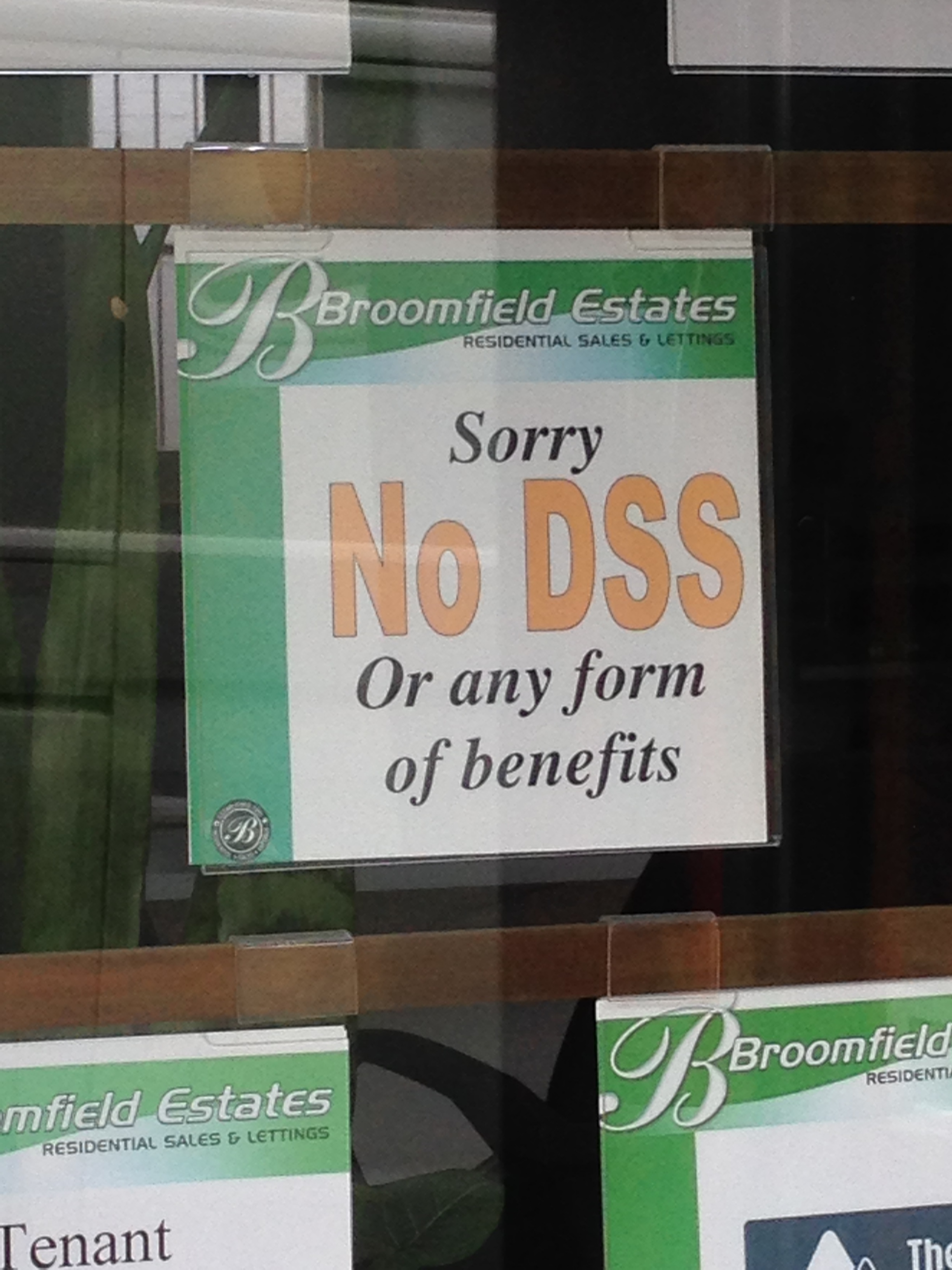
So where are the wheelchair accessible properties? I’ve found some on general property rental sites during my 8-and-a- bit-month search. They’re generally accessible by coincidence rather than design, and in new blocks of flats that definitely don’t want people like me applying; the kind that have concierges, and pot plants in the hallways. It goes without saying that they are not affordable, even with housing benefit. I could cover the difference for one or two months, and then I’d be out of money and back to square one. It also goes without saying that most properties, accessible or not won’t accept housing benefit, or sometimes ANY:

IMG_2620

Disability Discrimination is alive and well in the UK in 2017.

I suspect the answer is that accessible properties are dying out. The local council used to own many, which got sold off along with much of their general housing stock. The new landlords take out the adaptations, and raise the rent. They can deny installations of equipment needed to help disabled people live independently, and they can evict tenants without good reason just to redecorate a bit then hike the rent up. I haven’t been able to find somewhere to live in almost nine months with a very flexible eviction date, so I don’t imagine I’d do very well with just a month’s notice.Of course, if you can afford to buy your own home and make the necessary adaptations to it, that’s another matter. However, like many disabled people in the UK, I live on disability benefits and am therefore not allowed to save up for a deposit, though I do enjoy imagining the look on a bank employee’s face should I present my financial profile and ask for a mortgage. It seems the wiser thing to do should have been to wait until I had a career, savings, and a mortgage before becoming disabled. Silly me.

Through all this, I am struggling to keep my mental health together. I’ve worked really hard since January’s housing related episode to keep a balance, but when I got the forwarded email yesterday evening, my mood plummeted and I’ve been treading a dangerous line ever since. I can’t seem to engage with the council or think about the process without sacrificing the progress I’ve made since January, and I’m not currently in therapy because the CMHT doesn’t have enough staff to run the group yet (it seems once they’ve decided on the best course of therapy for someone, this can’t be changed due to such trivial things as staff cuts). I’ve spoken to the social worker there before, but she said she didn’t deal with the council because they never picked up the phone, so that’s another line of support cut.

In trying to be proactive, I’m writing this. Angry blogging is my first line of defence. Delegating research to friends who offer help is another. Does the council have a duty of care to appropriately house me, or does their responsibility end at offering me the chance to bid on unadapted properties? How much difference can getting my (shiny new Labour) MP involved make? Or the media? That kind of research. What also helps is that, unusually, I have quite a lot on my plate right now at least writing-wise, but this does rely on keeping the clouds from gathering in my brain. Once I’m fogged with depression, productivity becomes impossible.

Onwards, somehow!


Why I’m Suing A Bus Company

08 Tuesday Aug 2017

Posted by ninachildish in Blog, Disability

≈ 21 Comments

Tags

access, bus, suing a bus company, transport

I’ll get to the nitty gritty first:
I’m suing a bus company because their repeated lack of enforcing the wheelchair space is making me angry, especially after January’s Supreme Court declaration that bus drivers need to do more to ensure wheelchair users can board their buses. After January things in general got a tiny bit better, and then slowly reverted back to how it used to be – and then it got worse on one route that I use several times a week! Any instance where access gets worse rather than better, in my opinion, needs immediate attention. Since the spring, I have sent numerous complaints to the bus company in question, and each time I get the same response – “we will investigate the driver if we can identify them”, but of course I am not allowed to know the outcome of the investigation. But whatever has happened in said investigations, I see no overall improvement.

The company I am taking to court is based in London. TFL bus drivers can do three things when a parent with buggy refuses to move from the wheelchair space of their own volition. They can play an automated announcement requesting that the space is cleared for a wheelchair user; they can leave their cab to ask the parent/caregiver to fold the buggy; lastly, they can offer a transfer ticket for free boarding on the next bus if folding the buggy is either not an option or not something they want to do. In the numerous instances where I was not permitted to board the bus this year, including four times within two weeks, the most a driver did was to ask a parent to move but did not mention that the space was a priority space for wheelchairs, or offer a transfer ticket. I’ve even had multiple bus drivers claim that having two buggies on at once was an exception and that they couldn’t do anything if that was the case.

busfeet

Holding my ground/delaying the bus. This tactic didn’t work.

Despite this, when I am already on board a bus, drivers have no problem letting buggies on to push into my feet and ankles, block mine and others’ exit, or to huff at me when they find they have to fold their giant buggy up because I have unexpectedly occupied the wheelchair space with a wheelchair. It seems like there is a massively uneven system at work, and, by forcing a bus company to address this in court, I hope to further the rights of wheelchair users on buses and public transport.

Lastly, I’m doing this for the wheelchair users I know who are too scared to take buses on their own because they don’t feel that the bus drivers, companies, nor the other passengers have their backs. They feel, unsurprisingly, that they are seen as a nuisance, even though many bus companies have clearly marked priority wheelchair spaces. It’s the co-opting of these spaces by people who then refuse to move or make a big fuss over it which makes us feel that way. I’m doing this because we deserve to use the spaces that disabled people previously fought so hard for.

[I have checked with my legal team, and I’m okay to talk about this case on the internet as long as I don’t name the bus company in question.]

My wheelchair is not a prison!

12 Sunday Mar 2017

Posted by ninachildish in Blog, Disability

≈ 7 Comments

Tags

access, anxiety, disability, Mental Health, powerchair, rant, wheelchair

Since becoming visibly disabled in 2013, after several years in the invisible camp, I have been anxious about seeing people I used to know, and meeting new people. Not just the inevitable “what happened?” (answer: “technically nothing, I was born with this”), but the misguided sympathy I now get for being a wheelchair user. Non-disabled people tend to see the wheelchair as The Worst Thing That Could Ever Happen to someone – look at the terminology used: wheelchair-bound; stuck in a chair; confined to a wheelchair…. but they don’t think of the alternative. Before I had my electric wheelchair, I would leave the house once or twice a week, as it caused me that much pain to walk and the knock on effects weren’t worth it. Now, as long as I’m not in a bad fatigue phase, and can get what passes for “dressed” enough, I can go out multiple days in a row with only minor consequences.  Without their wheelchairs, tens of thousands of people in this country would have no access to education, work, or a life outside of their homes.
The futon is my prison, and the wheelchair is my freedom and my best friend.
I will admit to getting a bit (extra) depressed from time to time because I miss being able to do the things I used to love – dancing, climbing, scrambling, hiking (basically anything involving going up mountains), kayaking – but what people often fail to understand is that even if I didn’t need my wheelchair, or the crutches I sometimes use, I wouldn’t be able to do these things anymore anyway. The wheelchair is not the symptom of my condition or my limitations, it is the thing that helps me continue to do what I have left. So don’t aim your sympathy at my wheelchair -maybe channel it into anger at the lack of wheelchair access I and other disabled people face instead!
← Older posts

Support me on Ko-Fi

Buy Me a Coffee at ko-fi.com

search the blog

Categories

Recent Posts

  • Why Are Bus Companies Still Discriminating Against Wheelchair Users?
  • Access Review: Donmar Warehouse
  • Being the football.
  • The Medication Postcode Lottery
  • The Accessible Home Project pt1: The Stairlift

Tags

ableism access accessibility Accessible London access review Activism aids and adaptations anorexia anxiety benefits borderline personality disorder bus buying tickets campaigning chronic fatigue chronic illness CMHT complaint coronavirus council crip the vote depression diagnosis disability disability services DWP eating disorder ehlers-danlos syndrome ESA eviction Family fuck tropes general election gp Hamilton health heart failure Housing hypomania incompetence London managing chronic illness Mental Health Mental Health Awareness Week mental health services microaggressions money policing mother news New Year's Resolutions nightmare personal pip poetry positivity powerchair privilege product design rant recovery relationship self pity shopping sleep apnea social anxiety suing a bus company theatre therapy Tories transport Travel wheelchair wheelchair access work capability assessment writing

Website Powered by WordPress.com.

Privacy & Cookies: This site uses cookies. By continuing to use this website, you agree to their use.
To find out more, including how to control cookies, see here: Cookie Policy
  • Subscribe Subscribed
    • Nina Childish
    • Join 133 other subscribers
    • Already have a WordPress.com account? Log in now.
    • Nina Childish
    • Subscribe Subscribed
    • Sign up
    • Log in
    • Report this content
    • View site in Reader
    • Manage subscriptions
    • Collapse this bar
 

Loading Comments...