• About Me
  • Contact
  • Links to other stuff I’ve written
  • Useful Links

Nina Childish

~ and various brain kittens

Nina Childish

Category Archives: Disability

Where Are All The Accessible Properties?

31 Thursday Aug 2017

Posted by ninachildish in Blog, Disability, Housing

≈ 3 Comments

Tags

access, borderline personality disorder, council, depression, disability, Housing, Mental Health, personal

I came back from 10 days away to no emails from the council after our visit there a couple of weeks ago. The friend who is acting as my advocate sent them an email when I told him this, and got a quick reply that I should soon be able to look for private rented accommodation in the borough, then use their scheme to cover the deposit. Ignoring the fact that I should have been sent this information as soon as I had been approved (with J cc’d), the deposit is not what I am having problems with, as my dad has already offered to pay it (a small but arguably fair recompense for evicting me). The problem I am having is with finding suitable rented accommodation in the first place. Heck, it’s what I’ve been trying to do for the last several months! I was told first in June that I’d have to look for private rentals because the council itself did’t have any accessible properties on their books, but I only went through the council because I was having trouble finding any affordable accessible properties in the whole of London; limiting my search to one borough, even to properties that have agreed to house council tenants, seems doomed to fail. I’d optimistically hoped that if Enfield Council didn’t have any suitable properties then maybe they could refer me on to another council that did, or a housing association that the public can’t access independently.  Enfield do have a housing association that works with them, but I’m still waiting to see if I’ve been approved for referral. If I am, then I will have to see if they actually have any accessible properties either. If neither have any, then what?

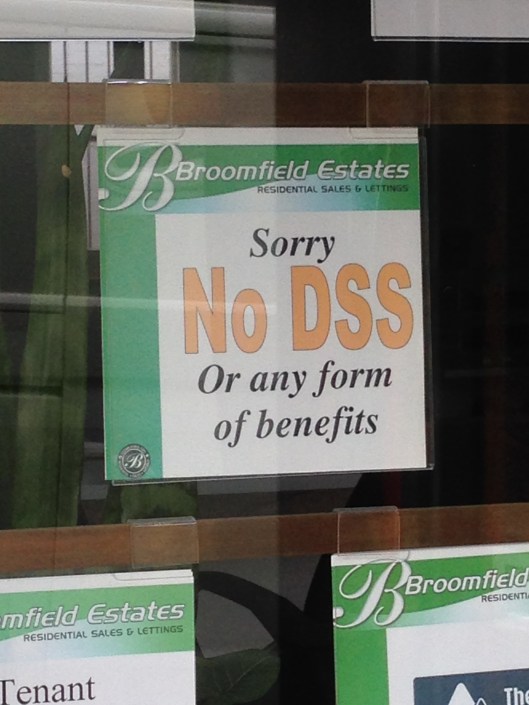
So where are the wheelchair accessible properties? I’ve found some on general property rental sites during my 8-and-a- bit-month search. They’re generally accessible by coincidence rather than design, and in new blocks of flats that definitely don’t want people like me applying; the kind that have concierges, and pot plants in the hallways. It goes without saying that they are not affordable, even with housing benefit. I could cover the difference for one or two months, and then I’d be out of money and back to square one. It also goes without saying that most properties, accessible or not won’t accept housing benefit, or sometimes ANY:

IMG_2620

Disability Discrimination is alive and well in the UK in 2017.

I suspect the answer is that accessible properties are dying out. The local council used to own many, which got sold off along with much of their general housing stock. The new landlords take out the adaptations, and raise the rent. They can deny installations of equipment needed to help disabled people live independently, and they can evict tenants without good reason just to redecorate a bit then hike the rent up. I haven’t been able to find somewhere to live in almost nine months with a very flexible eviction date, so I don’t imagine I’d do very well with just a month’s notice.Of course, if you can afford to buy your own home and make the necessary adaptations to it, that’s another matter. However, like many disabled people in the UK, I live on disability benefits and am therefore not allowed to save up for a deposit, though I do enjoy imagining the look on a bank employee’s face should I present my financial profile and ask for a mortgage. It seems the wiser thing to do should have been to wait until I had a career, savings, and a mortgage before becoming disabled. Silly me.

Through all this, I am struggling to keep my mental health together. I’ve worked really hard since January’s housing related episode to keep a balance, but when I got the forwarded email yesterday evening, my mood plummeted and I’ve been treading a dangerous line ever since. I can’t seem to engage with the council or think about the process without sacrificing the progress I’ve made since January, and I’m not currently in therapy because the CMHT doesn’t have enough staff to run the group yet (it seems once they’ve decided on the best course of therapy for someone, this can’t be changed due to such trivial things as staff cuts). I’ve spoken to the social worker there before, but she said she didn’t deal with the council because they never picked up the phone, so that’s another line of support cut.

In trying to be proactive, I’m writing this. Angry blogging is my first line of defence. Delegating research to friends who offer help is another. Does the council have a duty of care to appropriately house me, or does their responsibility end at offering me the chance to bid on unadapted properties? How much difference can getting my (shiny new Labour) MP involved make? Or the media? That kind of research. What also helps is that, unusually, I have quite a lot on my plate right now at least writing-wise, but this does rely on keeping the clouds from gathering in my brain. Once I’m fogged with depression, productivity becomes impossible.

Onwards, somehow!


Why I’m Suing A Bus Company

08 Tuesday Aug 2017

Posted by ninachildish in Blog, Disability

≈ 20 Comments

Tags

access, bus, suing a bus company, transport

I’ll get to the nitty gritty first:
I’m suing a bus company because their repeated lack of enforcing the wheelchair space is making me angry, especially after January’s Supreme Court declaration that bus drivers need to do more to ensure wheelchair users can board their buses. After January things in general got a tiny bit better, and then slowly reverted back to how it used to be – and then it got worse on one route that I use several times a week! Any instance where access gets worse rather than better, in my opinion, needs immediate attention. Since the spring, I have sent numerous complaints to the bus company in question, and each time I get the same response – “we will investigate the driver if we can identify them”, but of course I am not allowed to know the outcome of the investigation. But whatever has happened in said investigations, I see no overall improvement.

The company I am taking to court is based in London. TFL bus drivers can do three things when a parent with buggy refuses to move from the wheelchair space of their own volition. They can play an automated announcement requesting that the space is cleared for a wheelchair user; they can leave their cab to ask the parent/caregiver to fold the buggy; lastly, they can offer a transfer ticket for free boarding on the next bus if folding the buggy is either not an option or not something they want to do. In the numerous instances where I was not permitted to board the bus this year, including four times within two weeks, the most a driver did was to ask a parent to move but did not mention that the space was a priority space for wheelchairs, or offer a transfer ticket. I’ve even had multiple bus drivers claim that having two buggies on at once was an exception and that they couldn’t do anything if that was the case.

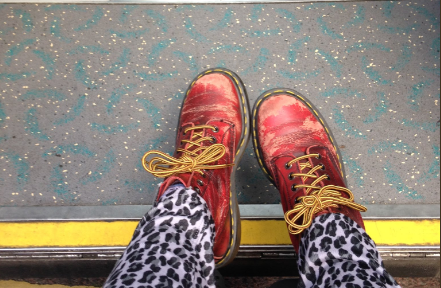
busfeet

Holding my ground/delaying the bus. This tactic didn’t work.

Despite this, when I am already on board a bus, drivers have no problem letting buggies on to push into my feet and ankles, block mine and others’ exit, or to huff at me when they find they have to fold their giant buggy up because I have unexpectedly occupied the wheelchair space with a wheelchair. It seems like there is a massively uneven system at work, and, by forcing a bus company to address this in court, I hope to further the rights of wheelchair users on buses and public transport.

Lastly, I’m doing this for the wheelchair users I know who are too scared to take buses on their own because they don’t feel that the bus drivers, companies, nor the other passengers have their backs. They feel, unsurprisingly, that they are seen as a nuisance, even though many bus companies have clearly marked priority wheelchair spaces. It’s the co-opting of these spaces by people who then refuse to move or make a big fuss over it which makes us feel that way. I’m doing this because we deserve to use the spaces that disabled people previously fought so hard for.

[I have checked with my legal team, and I’m okay to talk about this case on the internet as long as I don’t name the bus company in question.]

The General Election is this Thursday – let’s Crip The Vote!

06 Tuesday Jun 2017

Posted by ninachildish in Disability, Politics

≈ Leave a comment

Tags

crip the vote, disability, general election

Crip The Vote emerged as a digital movement in the first half of 2016 in the United States, and was an active voice leading up to the Presidential election that November. As noted by its founders, disabled people are America’s (and the world’s) largest minority group, but a group whose voice often goes unheard in politics, even on topics which directly affect them such as healthcare, and social services. From its origin as a hashtag on Twitter, it became a movement that spread across the internet and invited disabled voters to participate in grassroots discourse about how they could become more involved in politics and the electoral process. As the disabled community online crosses continental borders, it was only natural that once the General Election was announced on the 18th of April, #CripTheVoteUK soon followed.

It seems incredulous that a movement is necessary to point out where access improvements are needed, but that is part of what Crip The Vote does. This ranges from ensuring polling stations have full disabled access, to pressuring political parties to release their manifestos in all possible formats including BSL and SSE (Signed Supported English), large print, braille, and simplified English. The latter is thankfully becoming more common since Mencap’s campaign to include people with learning disabilities in politics. Some parties fare better than others at inclusion- the Conservative Party released their BSL manifesto too late for postal voters to see it this year.

Inevitably, a large part of the movement is based on drawing attention to parties’ policies which affect the disabled community, and urging people to vote accordingly. For that reason,  many of those participating in #CripTheVoteUK are committed to ousting the Tories who have caused unrelenting misery for disabled people in the UK since 2010 – be it from increasingly unfair ATOS or Maximus assessments, cuts to Legal Aid, NHS service cuts, cuts to disability benefits – disabled people have borne the brunt of the cuts made to keep our economy afloat, while the richest pay minimal tax and hide their money in offshore accounts. (By contrast, Jeremy Corbyn has repeatedly voted against benefit cuts, against the bedroom tax, and for increasing benefits in line with inflation – oh, and making millionaires pay their taxes!) Disabled people in the UK are literally dying from starvation, illnesses worsened by stress and poverty, even suicide after benefit errors, going without care hours when reclassified as being in less need, even being denied the wheelchairs that would help them engage in the community by the NHS who have been told to save money by tightening the eligibility criteria. We are being shat on from all sides, and we are sick of it. That is why Crip The Vote is so important; it gives us some agency back.

It’s hard to write a vaguely objective piece when it directly affects you so much, which is why somewhere in the last paragraph I dropped the formality. I’m not a journalist, I’m a blogger at most, but one who hopes that what they write might one day make a difference. So I’m starting here:
Abled Britons, non-disabled citizens, please read this warning. A vote for the Tories is a gamble, a bet that during a Tory government neither you nor anyone in your close family will become sick or disabled. As long as you remain in a stable job with a good wage, as long as your house remains standing, they have your interests at heart. Once the bricks start crumbling, once you get weaker, once you need to leave that good job to look after a spouse or child, they will not help you. They will punish you for a situation that was not your fault, make you feel as if just surviving another day is political dissent. At times the only thing that has kept me alive is knowing that I do not want to become another statistic, have my death called a “tragedy” by politicians who voted for me to have a harder life. I know my own experience is mirrored by many of my disabled comrades, and I also know it doesn’t have to be like this. This is why we are Cripping The Vote.

(If you want to vote tactically in your constituency to give your local Tory candidate less of a chance, you can check who you should be voting for on this handy website.)


My wheelchair is not a prison!

12 Sunday Mar 2017

Posted by ninachildish in Blog, Disability

≈ 7 Comments

Tags

access, anxiety, disability, Mental Health, powerchair, rant, wheelchair

Since becoming visibly disabled in 2013, after several years in the invisible camp, I have been anxious about seeing people I used to know, and meeting new people. Not just the inevitable “what happened?” (answer: “technically nothing, I was born with this”), but the misguided sympathy I now get for being a wheelchair user. Non-disabled people tend to see the wheelchair as The Worst Thing That Could Ever Happen to someone – look at the terminology used: wheelchair-bound; stuck in a chair; confined to a wheelchair…. but they don’t think of the alternative. Before I had my electric wheelchair, I would leave the house once or twice a week, as it caused me that much pain to walk and the knock on effects weren’t worth it. Now, as long as I’m not in a bad fatigue phase, and can get what passes for “dressed” enough, I can go out multiple days in a row with only minor consequences.  Without their wheelchairs, tens of thousands of people in this country would have no access to education, work, or a life outside of their homes.
The futon is my prison, and the wheelchair is my freedom and my best friend.
I will admit to getting a bit (extra) depressed from time to time because I miss being able to do the things I used to love – dancing, climbing, scrambling, hiking (basically anything involving going up mountains), kayaking – but what people often fail to understand is that even if I didn’t need my wheelchair, or the crutches I sometimes use, I wouldn’t be able to do these things anymore anyway. The wheelchair is not the symptom of my condition or my limitations, it is the thing that helps me continue to do what I have left. So don’t aim your sympathy at my wheelchair -maybe channel it into anger at the lack of wheelchair access I and other disabled people face instead!

(Lack of) Housing progress.

20 Monday Feb 2017

Posted by ninachildish in Disability, Housing, Mental Health

≈ 2 Comments

Tags

anxiety, eviction, Housing, Mental Health, personal

Just over two weeks ago I posted a tweet asking for help finding accessible rental accommodation in London. It was retweeted over 240 times, and garnered no replies.
This isn’t a damning verdict of community spirit – it’s a damning indictment of the lack of actually accessible properties on the rental market, and subsequently why, 6 weeks after beginning my housing search due to impending eviction, I have made exactly zero progress.

In terms of looking for private market property, I have used every website I can find. First off, I tried the site which has ostensibly taken over for the Accessible Housing Register, which currently lists a grand total of ZERO accessible properties available to rent inn the UK. So, onto the non-specialist sites. Disappointingly, NONE of them have any filters for accessibility – even dssmove.co.uk, which lists only properties which accept housing benefit – which means I have to search for listings mentioning “wheelchair” and see what comes up (usually not much). (Searching  for “accessible” will bring up red herrings as it is often used in context of local transport.)  Another method is to look for buildings with lifts, or ground floor flats only, but again there is no guarantee that this means they are wheelchair accessible. I have sent a multitude of messages to property agents about places on the market – checking either DSS allowance for those which are accessible, or wheelchair access for those which do accept DSS, or both – and the few replies I have had so far have been negative. I have, however, been signed up to numerous unsolicited mailing lists.

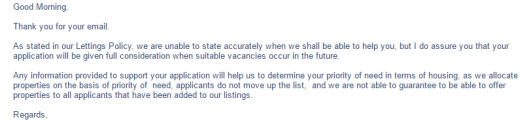
On the non-private rental side of things, progress has stalled. The meeting with my key worker at the Personality Disorder service, in which she promised to put me in touch with the department’s social worker to help me navigate the council, was over a month ago and since then I’ve heard nothing either by phone or post. I went to the middle-of-nowhere hell that is Enfield Council’s housing department and gave them my doctor’s note, so hopefully they won’t discard my application in the meantime. My other option is a specialist Housing Association. The only one I’ve contacted and heard back from is Habinteg- I was accepted onto their waiting list last year, when my housing situation was simply “undesirable” and not “6 weeks away from eviction deadline”. It took me a while to build up the nerve to contact them, by phone, and I was told to email them instead. That took me over a week, the anxiety of response made worse by the disinterested person on the other end of the phone. Then I got this back:

habintegreply

[Good Morning,
Thank you for your email.
As stated in our Lettings Policy, we are unable to state accurately when we shall be able to help you, but I do assure you that your application will be given full consideration when suitable vacancies occur in the future.
Any information provided to support your application will help us to determine your priority of need in terms of housing, as we allocate properties on the basis of priority of  need, applicants do not move up the list,  and we are not able to guarantee to be able to offer properties to all applicants that have been added to our listings.
Regards,]

No contact name given, not even a mention of my name. I am pretty sure I was given a template response. I’m not even sure anyone read my original email stating I was facing an eviction deadline. After another few days of fretting, I’ve sent a copy of the eviction notice but I don’t expect more than another pithy email possibly telling me that it was insufficient evidence. I’m trying not to get utterly depressed at the probable loss of what was, at the start of this anxious period of my anxious life, my best hope at being suitably housed.

Update 21/02 – I have received an email from Habinteg informing me that my emails and evidence have now been forwarded to a Housing Officer. Whether or not this is so they can tell me the same thing, I’m not sure.

As the days count down to the provisional deadline of March 31st, my mental health is piping up again. Last night I had the first seizure I’ve suffered this year, and the first in at least a few months. I’ve begun dreading the evenings and nights again, in case of the Sudden Desperate Sads which lead easily to desperation, dissociation, or worse. I’m waking up anxious, staying anxious, until it turns to depression as the day wears on. I know this is when I should be calling the PD service key worker, but the lack of contact I’ve had from them since the Crisis Week means I’m incredibly anxious about doing so.

Game Face

31 Saturday Dec 2016

Posted by ninachildish in Blog, Disability, Family, Housing

≈ 2 Comments

Tags

anxiety, eviction, Family, Housing, personal

“I don’t think I can have you stay in my flat any longer. I want you gone within three months.” And with that announcement, delivered three days after Christmas, my father broke into a smile.
“There. Now I have that off my chest we can get on with enjoying the holiday.”

And remarkably, he has. Ever since dropping that bombshell on me over breakfast on the 28th, he has been eerily pleasant as if the idea had been pressing on his mind and now he had said it out loud it was no longer there. It’s crushing me, instead.

I wish I could say I was new to being thrown out by my parents. The fact is I ended up at my dad’s when my mum threw me out in early 2014. Before that we have to go back to 2003, age 17, when I wasn’t thrown out but more “had to leave” my dad’s flat for legal reasons – two years after my mum sent me to live with him when dealing with a suicidal teenager became too much of a hassle for her. After a period of homelessness and hospitalisation, I got my own flat in 2004, and stayed a tenant of a supported housing agency until I gave it up (and all the disability benefits too) to go to university. Although I knew my mental health was precarious, I had no idea at that point that I also had a genetic disorder affecting my connective tissue, and that within 8 years I would be a wheelchair user, unable to work, and back living at my dad’s because I couldn’t get an income.

 I have no idea how long he’s wanted to throw me out for. Periodically he’s complained that I’m not making an effort to find accommodation, to which I point out that I’m still waiting to hear back from the council – that private accessible accommodation that accepts housing benefit is hard to find is a gross understatement. Truthfully, my plan was to wait until I heard back from my last PIP assessment – firstly so I knew if I would be able to afford the move, and secondly (and more importantly) so I would not have to deal with two major stressors at once. Dealing with one thing at a time is how I manage my mental health. If I try to take on too much at once, it can go very badly. But he’s forced my hand here. I have to find somewhere to live before the end of March, even if I have to take my PIP claim to appeal again.

He’s always been very territorial about his flat. Despite my living there as a teen, it was always HIS. He resented that it was to his flat that my boxes would come back to when moving to uni, moving abroad, moving back in. He resents more when I get too comfortable. And heaven forbid I let my mother in….. part of me feels that my offhand comment on Boxing Day about mum “popping round” in the new year may have been the straw that broke the camel’s back. He’s expressed discomfort with my familiarity with the flat before. The few non-fixed adaptations and equipment prescribed by the council’s occupational therapist have mostly been consigned to the conservatory. He doesn’t want a cleaner in HIS flat (despite never being there to clean it himself). The powerchair in the hall is tolerated, although the wheelchair ramp, which I negotiated long and hard for, is considered a symbol of my “settling in”. Ironic, since it’s the thing which enables me to LEAVE the flat most of the time. Essentially, I’ve always known my residence would be temporary. I’ve been reminded constantly.

So, having had two days to take it in, I’m feeling relatively calm. Enforced calmness was necessary to avoid a stress induced breakdown 4 hours from home where all my information is, in a house where the internet is unreliable at best and any supportive family had left the day before. I had my necessary cry, and my small rage, and then I put on my grown up face and asked him to please give me a letter for the council stating intention of eviction by the end of next week. With luck, common sense will overrule spite and he won’t say I have made myself “voluntarily homeless” as he’s been threatening to. I’m not sure it would stand anyway, since I’m not a tenant and there was no contract for me to break the terms of.

In the coming weeks/months I will be blogging about my search to find a new home, and probably also drawing parallels with my experiences at 17 which so far I haven’t had the guts to because of associated PTSD. This is going to bring those memories bubbling to the surface though, so writing them out will be one way to take control. 

So. Let’s find an accessible place in London that also accepts housing benefit. Game face: on.

PIP – my recurring nightmare

17 Monday Oct 2016

Posted by ninachildish in Blog, Disability, DWP, Mental Health

≈ 2 Comments

Tags

anxiety, benefits, personal, pip

Sunday night, late September

Well, it was a blissful four months without any DWP contact at all. A glorious summer devoid of this specific anxiety, along with the harsh, tinny compressed tones of the Four Seasons that inevitably accompany it (due to Vivaldi-specific PTSD, I will never listen to that piece for pleasure again). It was also a summer of drastically worsening illness, in terms of fatigue and autonomic dysfunction, but also, paradoxically, much improved mobility as my powerchair arrived in June.

Now summer is over. The brown envelope arrived the day after our return from our late holiday in Vienna. The timing couldn’t have been more symbolic.
Your PIP runs out on December 17th. Please reapply.
I knew I would be facing reassessment this year, even though I only received my first payment in January. I knew I’d only get a year. But I didn’t realise that I would have to fully reapply, not renew. This has sent me into something of a mental spiral, remembering all the stress, anxiety, extra dissociative episodes which occurred while trying to complete the original form – and realising that I will probably have to do this all over again – perhaps only to be told that I don’t qualify after all and that I will have to go through another appeals process.

It’s past 5 in the morning. I’m too anxious to sleep even though tomorrow is only the phonecall to clear up the renewal/reapplication confusion. My brain kittens figure it never hurts to panic early.

Monday evening, mid-October

The forms have arrived. It took me over a week to summon the courage to call the number and wait on hold through 40 minutes of pain and intrusive noise last month. I asked about reapplication vs renewal, and got told that whatever was on the letter I was sent, that’s what to do. So starting again it is. The deadline is November 7th, so I doubt I will be assessed in what remains of 2016 (last time I waited 7 months from sending the application to the initial assessment).
This means that I will lose almost £62 a week from December when my PIP runs out, until it  is (potentially) reinstated, as the Severe Disability Premium added onto my ESA is reliant on my getting PIP. It’s almost like they expect me to fail.

We’re doing the forms tomorrow evening, using the ones from 2014 as reference. I know that a worsened condition (both physical and mental) gives me no guarantee that I’ll get the points to reflect this. Cynically, I think it would be a miracle if I even matched last year’s results (Enhanced rate care; nothing for mobility). I had to go to a tribunal to get that. I’m not sure I can deal with another year of my life essentially put on hold so I can ensure I have the support I need. It’s a bloody grotesque system.

The email I wish I was sending.

04 Tuesday Oct 2016

Posted by ninachildish in Blog, Disability

≈ Leave a comment

Tags

ableism, chronic fatigue, ehlers-danlos syndrome, mother, personal, powerchair, rant

[CN: abusive parents, disability shaming, fat shaming, mentions of weight.]

I got an email from my mother last week, after we met for a coffee last Friday. It was the first time she had seen me using my powerchair and, looking back at the suspicious lack of comment, I guess she was saving her opinions so not to spoil the afternoon.

So the email came. Usual niceties “lovely to see you”…. then:

However, seeing you in the electric wheelchair, I can’t help feeling concerned about your well-being.

Followed by some information copied and pasted from the official EDS-UK page about how important exercise is.

I had to close my laptop before I wrote the email I wanted to reply with. It’s taken me up until now to feel like I can even write it as a cathartic exercise. I’m still not sure I’ll be able to send an actual reply without putting some sort of barb in there. Her attitude towards my newly-rediscovered mobility isn’t exactly a surprise; she has a long history of dismissive behaviour when it comes to my health, especially things which are visible. Here are a few notable examples:

  • I pulled tendons in my racket arm during a PE class when I was 13. That weekend said we could go out for a meal (a rare treat)….but only if I removed my sling.
  • A bad concussion the next year, via an accident in drama class, was dismissed with “just sleep it off”, although the school nurse had told her to take me to a doctor. I spent the weekend groggy on the sofa.
  • When I was 15 she gave my knee supports away to a friend’s daughter.

I suspect my childhood list only ends there because I stopped living with her when I was 15. I’m not even going to get started on the mental health stuff. That’s a whole other barrage of awful (“I think I’m depressed.” “Don’t be so silly.”). In adulthood it hasn’t gotten much better. I lived with her for a brief while after uni; on more than one occasion she barged into my room in the early afternoon, pulled my covers off, screamed at me to get up, to stop being such a lazy bitch. I didn’t have a diagnosis at that point, but tried to explain that it wasn’t just “being tired”. She shot back with “I’ve had two children under five, I was tired but I got up”.  In my imagination I shout “BUT YOU COULD!” after her. Now I do have a diagnosis, I’m not a “lazy bitch” anymore, at least out loud.
So here’s the email I wish I could write.

Dear Mum, 

Thank you for your email expressing concern over my newfound ability to leave the house whenever I want. However it has raised some questions for me which I hope you can answer. 

Are you embarrassed to have a disabled child? 
Because that’s how it’s coming across – that it’s fine for me to have this condition (that you never bothered learning about until you could try and use it against me like this) as long as it’s not visible to others and especially not when I’m with you.

Why the concern now? 
Was it not concerning when I was unable to leave the house for weeks at a time?
And if not, was this because at least I was being disabled out of the sight of others?

Why is my weight gain more concerning than my ability to leave the house?
(You are aware that I became exercise-intolerant long before I got the powerchair, right?)

I hope to hear from you soon. 
Love to you and [insert name of current partner],
Nina

That was far politer than I had intended. I can’t even unleash the fury on a vaguely-anonymous blog. In my head I’d made a huge list of things that were not “concerning” which had a far greater impact on me (such as when I told her my dad was physically abusive and she told me it wasn’t illegal so she couldn’t do anything) – but gain a stone and THAT’s cause for concern.

What I will write will probably be polite, terse, and contain a link to something about the detrimental effect of exercise on exercise-intolerant patients with chronic fatigue. No  questions, no accusations, maybe a “you’ve never been in my situation so stop judging me” at the worst. I wish I could send the one up there, but I’m scared of the reply. I’m embarrassed that her opinion can do this to me. Every time something like this happens I come closer to just cutting her off.


The Nearly Universal Cupholder

05 Monday Sep 2016

Posted by ninachildish in Disability, Reviews

≈ 4 Comments

Tags

aids and adaptations, disability, product design, wheelchair

Yes it’s a product review. I’m sorry. But it’s also my first one so please show leniency.

I wanted a cup-holder for my wheelchair. Sure, without both hands taken up with crutches I can hold a coffee, or put a bottle of water on my lap, but it always leads to confusion, stuff-balancing, cold legs, hot hands, or a mix of various pains and faff. I was given a cup holder meant for buggies a while ago, which needs a cylindrical frame of a certain diameter to fit.  However, my powerchair doesn’t seem to have this at all, except in places I can’t reach. Unhelpful. Most wheelchair cup-holders I could find seemed to be clamp-based which wouldn’t work on my chair either, due to the hardware under the arms.
I’d been keeping an eye on the Nearly Universal Cup Holder for a while on Amazon UK, torn between the reviews (overwhelmingly positive) and the price (£17.95 – a little prohibitive for what is essentially a piece of plastic and some Velcro) but in the end after yet another frozen-frappuccino-hand I decided to give it a go.

File_000 (1)

Setup was pretty easy – I was concerned about the amount of hardware underneath the arm as Quickie powerchairs are wont to have, but the Velcro straps were no problem. Without using the extra foam pads provided, there was only about a 1cm give each way when gently jiggled. It’s easy to remove, if you have to squeeze into a tight gap (and I would recommend removing it if you’re not totally sure, in case of breakage).

I recommend this product if you have a wheelchair or powerchair with standard width arms (mine are just over 2″ across) – and if you’re not sure if it will fit your chair, the OH-4 website has a contact form so you can check before you buy (you don’t have to buy from the USA website – it’s on Amazon UK).

Happy drinking!

Update, Dec 2018 – I’ve now been using this product for over two years and it’s held up remarkably well. It’s more robust than I’d imagined – I often use the cupholder to hang my shopping bag off too and it hasn’t warped or bent at all! This durability makes it incredibly good value for money in my eyes. 


The buggy/bus saga rolls on….

30 Tuesday Aug 2016

Posted by ninachildish in Disability

≈ 1 Comment

Tags

access, bus, disability, transport, wheelchair

(Again, apologies for the formatting. I wrote this on my iPad and copied it over.)

The wheelchair vs buggy on the bus debate is continuing to roll on, with the Supreme Court ruling yet to be announced, more than two years after Doug Paulley opened his landmark case against a transport group for failing to ensure wheelchair users could use the spaces legally provided for them.

I’ve seen a lot of posts from parents this year on various platforms not only arguing
their rights, but equating them with those of the disabled people they are
keeping from accessing public transport, so I thought I would make an
annoying list of bullet points to round up my errant brain kittens on
this. Warning: will contain personal experience and also instances of
ableism.

(All points assume that neither the parent nor child is themselves
disabled. If a disabled child in a wheelchair buggy is in the
wheelchair space, well, it’s a wheelchair space, and that is a
wheelchair.)

So important it doesn’t get a number: the bleat “You wanted equality
now you have equality” holds no water here. This is not equality, not
when a non-disabled person can sit anywhere in the bus (or indeed
stand if there are no seats) but a wheelchair user only has one
option. Not equality, but it is a small step towards equity.

1.      The wheelchair space on the bus is the only place which a
wheelchair user – be it manual, transport or powered – can safely
travel. Most wheelchairs are too bulky to be able to go anywhere else
without blocking the aisle, even if they don’t move while the bus is
in motion.
2.      For most bus companies, the current rule for parents with buggies
is that they may use the wheelchair space if it is not needed by a
wheelchair user. This is clearly marked on signs in the wheelchair
bay.
3.      According to the Big Red Book (the driver’s manual for TFL buses), upon trying
to board a wheelchair user when there is already a buggy in the space,
drivers are first supposed to play the automatic announcement and, if
this doesn’t work, then go and ask the parent to please fold the buggy
so that the wheelchair user can board.
4.      The rules are apparently made to be broken: more often than not a
driver will shrug apologetically and say they have a buggy on board.
This kind of driver is unlikely to actively engage with the parent, so
I have to ask them to open the middle doors so I can speak to the
parent myself and plead with them to let me on. It’s not dignified,
but sometimes I can’t afford to wait for the next bus – hell,
sometimes this IS the next bus!
5.      Obviously this doesn’t work all the time – it’s pretty much 50% in
my personal experience, and half the time I do board (size of
wheelchair space dependent), I have to slot in next to an unfolded
buggy, in an “illegal” position. It’s okay in my powerchair, if not painful due to people continually bumping into me,  but
manual chairs are far more prone to tipping and this could be very
dangerous especially as UK buses don’t seem to have
restraints/wheelchair belts.
6.      If a buggy won’t fold at all, the driver is supposed to offer a
transfer ticket for the parent to board the next bus at no cost. I
have yet to hear a driver offer this to anyone.
7.      Should a parent flat out refuse to vacate the space, fold the
buggy, or reposition themselves so that we can unsafely share the
space (massively compounded when two or more buggies are present), a
wheelchair user will be unable to board. However, there have been
numerous times where I have used a previously unoccupied wheelchair
space and the driver has allowed a buggy on board to block me in, or
block the aisle. Yes the buggy is (often) smaller than a wheelchair,
but it smacks of double standards.
8.      The most controversial point… A baby is not a disability. Sorry.
Sure it’s inconvenient lugging a buggy around, but the right to co-opt
spaces that disabled people fought for doesn’t come with that
temporary impediment. It’s almost as if everyone has forgotten that
before disabled people literally chained their wheelchairs to buses in
protest for access, all buggies had to be folded before boarding
anyway. Years of access to a space created for disabled people has led
to entitlement and apathy. Why not join growing protests for TWO
accessible spaces on the bus, or start your own movement with other
parents? The benefits of disabled victories are not yours to reap with
impunity.
9.      A little bit of empathy goes a long way. I’ve let buses leave
without me, with buggies on board, knowing that there is another bus
not far behind. Similarly, I’ve had a mum with a baby get off a stop
early so I could board. I know there’s a striking juxtaposition
between this point and the last point. Consider point 8 aimed at those
who insist that their rights to have a giant unfoldable buggy trump
everyone else’s, and point 9 an ideal case of working stuff out in a
non ideal situation.

← Older posts
Newer posts →

Support me on Ko-Fi

Buy Me a Coffee at ko-fi.com

search the blog

Categories

Recent Posts

  • Access Review: Donmar Warehouse
  • Being the football.
  • The Medication Postcode Lottery
  • The Accessible Home Project pt1: The Stairlift
  • burning

Tags

ableism access accessibility Accessible London access review Activism aids and adaptations anorexia anxiety beauty benefits borderline personality disorder bus buying tickets campaigning chronic fatigue chronic illness CMHT complaint coronavirus council crip the vote depression diagnosis disability disability services DWP eating disorder ehlers-danlos syndrome ESA eviction Family fuck tropes general election gp Hamilton health heart failure Housing hypomania incompetence London managing chronic illness Mental Health Mental Health Awareness Week mental health services microaggressions money policing mother news New Year's Resolutions nightmare personal pip poetry positivity powerchair privilege product design product review rant recovery relationship self pity shopping sleep apnea social anxiety suing a bus company theatre therapy Tories transport wheelchair wheelchair access work capability assessment

Website Powered by WordPress.com.

Privacy & Cookies: This site uses cookies. By continuing to use this website, you agree to their use.
To find out more, including how to control cookies, see here: Cookie Policy
  • Subscribe Subscribed
    • Nina Childish
    • Join 133 other subscribers
    • Already have a WordPress.com account? Log in now.
    • Nina Childish
    • Subscribe Subscribed
    • Sign up
    • Log in
    • Report this content
    • View site in Reader
    • Manage subscriptions
    • Collapse this bar
 

Loading Comments...