• About Me
  • Contact
  • Links to other stuff I’ve written
  • Useful Links

Nina Childish

~ and various brain kittens

Nina Childish

Author Archives: ninachildish

Access Review: Donmar Warehouse

18 Tuesday Feb 2025

Posted by ninachildish in access, Accessible London, Reviews, Uncategorized

≈ Leave a comment

Tags

access review, Accessible London, Covent Garden, Donmar Warehouse, London, theatre, wheelchair access

We first went to the Donmar Warehouse, located in Covent Garden, in January 2022 for their production of Force Majeure and I was left wondering why on earth I was anxious about going there – being a small venue I had fears of limited accessibility and crowding but that couldn’t be further from my experiences at this singular space. Since that first visit we’ve been back a few times and every time I’ve been amazed with what can be done with such a small, intimate space without ever feeling claustrophobic. Even the impressive musical Natasha, Pierre & The Great Comet of 1812 fit perfectly in the space, where the audience surrounds three sides of the stage for a different perspective.

Getting Tickets

The Donmar operates its own access scheme; once signed up, disabled patrons can book their tickets online at a discounted rate and add a companion ticket for free.

Getting There

The evening we went to see Natasha, Pierre …, there was unhelpfully no Jubilee Line running but it was a nice wander/wheel on a wintery London evening from Green Park to Covent Garden. The Elizabeth Line also gives the option of going to Bond Street. Covent Garden station itself is notoriously inaccessible (there is a lift, but then a flight of steps afterwards) and in busy periods may be designated exit only to prevent overcrowding (but the larger Leicester Square station is very close by). Tottenham Court Road is the nearest accessible station (8 mins away) but doesn’t work the route we come into London by.

Entrance

Level access into the main foyer of a theatre in the West End? Just like every other patron? What trickery is this?! But it is, indeed, level from the street into the foyer-bar area of the Donmar. It can be a little crowded to get through as it’s quite a narrow space, and the lift is at the far end past the box office and bar. One floor up takes you to the main level where stalls (including wheelchair space) and a bar are; the second floor has all toilets and another bar plus seated spaces. The lifts also have their own battery backup in case of power outage, which is a nice addition.

Wheelchair Space

The wheelchair spaces at the Donmar are on the ends of the bench row seats in the stalls which means it’s impossible to get into place until everyone else has taken their seat, and it can be a bit of a squish in a small space while this is worked out. The view to the stage is excellent due to it being a small theatre, but depending which of the 3 blocks of seating you’re placed in there can be an impeded view of the “scaffolding” area above the stage if this is used. The major disability access issue with the Donmar is caused by what makes it so special, sadly: its intimate setting. In this space the aisles are often used as part of the performance area and have been utilised in each of the shows I’ve seen there. As a result, there is a strict policy of no reentry not just for etiquette but safety reasons. If you have to leave to go to the bathroom or attend to any medical needs during the performance, there are screens in the bar so no one misses out fully. If you are worried about this affecting your visit, talk to a member of staff when you arrive.

Services

The Donmar Warehouse offers audio described and captioned performances of their shows, with details of these available on their access page. They also offer a comprehensive visual story if you want to know exactly how things will go and what everything looks like beforehand.

Toilets

All toilets at the Donmar are on the second floor, while wheelchair spaces are in the first floor stalls which can make it a bit of a rush to use the facilities if you don’t arrive in plenty of time (necessary to avoid falling foul of the ‘no reentry’ rule). The corridor with the toilets is rather narrow, and behind a heavy fire door, which are both quite difficult for wheelchair users but there are usually other people around to hold the heavy door open – all you have to do is try not to swing the two-way door to the accessible loo into the queue for the ladies’ when you exit!

Overall I can’t really praise the Donmar enough. What they’ve managed to do with such a small space in a converted 17th century banana warehouse is incredible, and, as their social media says, when you go and see a show in their intimate venue you’re never more than four rows away from an actor (yes even in the wheelchair spaces!).

Being the football.

27 Thursday Jun 2024

Posted by ninachildish in Disability, DWP, Politics, Uncategorized

≈ Leave a comment

Tags

benefits, Conservatives, disability, DWP, economy, general election, Labour, news, pip, Politics, Tories

With a general election happening in a matter of days now, it is with utter predictability that Rishi Sunak – the presumably outgoing Prime Minister and multi-millionaire married to the daughter of a billionaire – is throwing out some lazy appeasements to the taxpayers/dodgers in an attempt to claw back some of the former Tory voters who’ve wandered over to Reform or Reclaim or any of the other loony fringes of right wing populism. As ever, benefits are a popular way for the Tories to direct their voters’ focus onto easy targets (the unworking! the useless eaters! the single mothers!) and this time it’s PIP (Personal Independence Payments) that is under scrutiny. PIP is a benefit that anyone can get, working or not, with savings or assets or not, as long as they are disabled enough to qualify. It has two components – “daily living” and “getting around”. Someone getting the maximum of both components who isn’t using the mobility portion to lease a car via Motability (the “free car” legend still lives rent free in some heads) will be getting just north of £700 a month at time of writing. However, from the “man on the street” interviews some media have done it appears that the general public don’t know much about it, as in the ones I read and saw many people mentioned how Sunak’s proposed changes will “encourage people back into work”. Maybe we should encourage people to research the subject before opening their mouths. Anyway, I’m preaching to the choir here I know, but without PIP many disabled people wouldn’t be able to work in the first place, without help to cover the extra costs involved in getting to and from work and managing throughout the working day. Because that’s what PIP is for on paper – levelling the playing field by helping with the extra costs of being a disabled person in the UK. These costs are ongoing, because our disabilities and conditions are ongoing. Which brings us to the takedown of the shakeup:

Scheme 1 – ONE OFF PAYMENTS:
The first of Rishi’s ideas to possibly replace PIP is one-off payments for adaptations. Here’s a radical thought: these should already be a thing. Not instead of PIP, but on top. Currently, disabled people can apply for grants via their local authority for help towards ramps, stairlifts, door widening etc. but this is means-tested and takes into account the income of partners as well as that of the disabled person themselves (and is why we don’t have a level access back door yet.) I’m sure if the one-off-PIP was introduced, some people who don’t qualify for such grants would appreciate the ability to make their home as accessible as possible – there, I said something nice about it. However, what good will that do the many people who live in homes that have already been adapted? Would we get money back for works already paid for? Most importantly, there are many people who qualify for PIP who don’t need any home adaptations at all, and it once again feels like mental health, neurodiverse and developmental conditions are being ignored in the name of cost-cutting. Of course, the big issue with the idea is that one-off payments, even if they help with the costs of adapting homes for those who need it, won’t help with covering the ongoing costs of disability and chronic illness be it taxis, extra use of water/heating/electricity, private therapies etc. that PIP is supposed to be an equaliser for. If they’re truly one-off, they also wouldn’t cover later necessary adaptations – say, for someone who uses a walker and can manage with grab-rails and a stairlift, but later uses a wheelchair which needs a ramp to be able to enter the property. Also, since this would still be managed by the DWP, I imagine applications would still be scrutinised by unqualified assessors who will turn a good number of them down. Plus ça change. So, my verdict on payments for adaptations is that they’re a good idea on paper, yes, but only as an adjunct to the existing PIP payments, not as a replacement.

Scheme 2 – VOUCHERS
The idea of benefits being paid in voucher form is a longstanding favourite of many who complain about benefits being a “lifestyle choice”. It’s a popular topic for below the line discussion about most benefits, such as Jobseekers Allowance and ESA (but not the state pension, never the pension). The commenters in these cases seem to think that anyone claiming money from the state has a responsibility to only spend it in a way that they, The Taxpayer, explicitly approve. This, of course, means no cigarettes, alcohol, Sky TV (the classic combo)… or in 2024 terms no vapes, no takeaway coffee and no Netflix. This kind of thinking starts with “no luxuries allowed” and ends with “you can survive on beans on toast”. In a pique of irritation with this attitude, I may once have ended up telling someone that it was no matter to them if I spent every penny of my benefits on pick & mix and then found myself unable to pay my rent! As a way of breaking down the problems inherent with the voucher idea, I’m going to see how it would hypothetically handle a few things my own PIP is spent on currently and in the past. So first, non-prescription medications and supplements: I take a lot of these, so for cost saving measures I tend to use Amazon as the alternative is spending an eye-watering £210 a month on Co-Enzyme Q10 alone from Holland & Barrett (my cardiologist continues to apologise that it’s not available on prescription “but please keep taking it”). Would this voucher system let claimants buy products online, and if so would it limit them to “approved” retailers such as supermarkets? Many recipients of PIP cannot get out to the shops to buy things they need and rely on online shopping for everything from groceries to personal care products. Then there’s the matter of paying others for the things we can’t do ourselves: I didn’t qualify for council care, so when I lived alone I hired a friend to work as my PA. He would come over for an evening most weeks to help me blitz the laundry pile, hoover the floors, tackle the kitchen chaos and make sure I managed to have a bath without passing out either during or afterwards. I paid him by bank transfer, but if PIP were given in vouchers or pre-pay card format then presumably it wouldn’t see a bank account at all. And now, although this is something I keep meaning to expand on in another post, now I live with my partner in a house of our own – and as a result, PIP is the only income I have, the only guaranteed money coming into my account. It is how I pay for my share of the food, and the bills. I will argue until I’m blue in the face that this too is a cost of disability, because I can’t earn a salary and my ESA has been stopped for the crime of cohabiting. There are many disabled people like me, who find themselves with drastically stripped down benefits after making such a move, and for this reason PIP in vouchers or one-off payments would be a disaster for us. How can I contribute to my household if my sole income comes in voucher form?

"The things I need, I want to choose myself"
A disabled lady on #questiontime sums up why payments for specific adaptations or vouchers are not what people on PIP want or need or will be helped by. Our needs are different and varied. #disability #CripTheVoteUK

— ⚫️ Nina – CRIP THE VOTE UK 2024 (@notwaving) June 13, 2024

So here’s the thing – Rishi Sunak is unlikely to remain the Prime Minister after this election; all signs point to Labour regaining the higher ground and Keir Starmer taking the reins. This means that Sunak’s statements about shaking up the disability benefits system will likely come to nothing. However, I feel that after 14 years of Tory cuts and scapegoating of benefit claimants (disabled or otherwise) that things aren’t going to be much better under Labour, or anyone else. It’s a depressing thing to say, but I feel the best I can hope for after this election, as a disabled person on benefits in this current climate, is that nothing changes – not because the current system is a just one, but because in my experience as someone who first claimed (what was then) DLA in 2004, change to the benefits system has been progressively more weighted against those who it purports to help. Maybe I’m just feeling mentally and emotionally drained after seeing my “lifestyle” (ha!) tossed up and thrown around like a political football, dissected in newspaper articles and op-eds, discussed in fabricated detail by people who wouldn’t recognise chronic illness if it smacked them in the face, let alone spent weeks unable to leave the house* because of it (*not during a global pandemic). Underneath my fear and weariness, I do realise that these PIP changes are most unlikely to happen and that Labour are similarly unlikely to want to do an overhaul of the benefits system – at least one to the wider detriment of the people who use it. The problem with being the subject of a political football, though, is that even if it only ever remains outlined in speeches and articles and never even gets close to scoring, you still feel rather, well…kicked.

The Medication Postcode Lottery

20 Wednesday Mar 2024

Posted by ninachildish in Blog, Disability, health, Uncategorized

≈ 1 Comment

Tags

Blog, chronic fatigue, chronic-pain, health, heart failure, medication, Mental Health, NHS, personal

We’ve lived here in this small city for 8 months now, owned the house for 9 months – not that you’d know it with us not even being fully unpacked, rooms half painted and half-finished. Despite our slow progress, it’s been easy to settle into life here. Our neighbourhood is calm but cheery. The right mix of students and families. Norwich doesn’t have an awful lot going on, at least compared to London, so there’s less choice when it comes to gigs and theatre, but at least we have some choice at all even if the University is the largest music venue on offer! It doesn’t lack in independent coffee shops and record stores, either. Change hasn’t been so hard, I was expecting more pushback from my subconscious. Maybe it’s just that our home is so lovely it’s making it so much easier to adapt. At least for the most part. Nothing is ever actually so simple…

I knew when we moved I’d have to shuffle some medical stuff around. A few things would have to be re-referred up here, but some would stay based in London where the speciality centres were. I wasn’t expecting to find myself a victim of NHS postcode lottery, though. My new GP flagged it up almost immediately when reviewing my medication list – “oh, that might be an issue…”. Modafinil. It’s a narcolepsy medication, which my cardiologist prescribed to me off-label near the end of 2020 in the hopes it would help the crushing fatigue and cut through the brain fog a bit, give me more ‘useful hours’ to work with. It’s not a miracle drug but has made a marked difference to me, especially in terms of preventing ‘rebound naps’ within a few hours of getting up (which used to be almost daily) and in the amount of focus I have (already terrible thanks to unmedicated ADHD, brain fog makes it far worse). On Norfolk’s NHS prescription board, however, Modafinil is Double Red listed (I presume based on abuse potential, not cost), which means it can only be prescribed for narcolepsy and must be prescribed by a specialist in this disorder. This obviously doesn’t include me. I’ve appealed to the board twice via my GP, but to no avail. My next options are to wait 6 months for my next cardiology review to see if they can prescribe it to me directly again (unlikely as they prefer your GP to do this after the trial prescription) or to pay for a private GP appt and private prescription (expensive to the point of being unsustainable long term). Getting some kind of delayed reprieve from the board based on having taken the medication successfully for three years with only positive effects is, sadly, unlikely to happen.

So as of now, I’ve been almost three months without the medication that helped me manage a bit more like a functioning person. For a month or so as I was running out I picked the days I wanted to take the Modafinil, based on how long I’d have to be awake or how much I needed to do that day, and took my last dose on Christmas Day. Inevitably I started spiralling a bit as I reached the last dose, anxious about losing what function, what hours of clarity and ability I had. It’s been better than I’d feared, in reality, but it’s been quite foggy and I don’t feel my year really started until mid-February. It’s nearly the end of March now and this is the most I’ve written at once so far this year (two coffees don’t really have the same effect). Before this happened, I had no idea the kinds of medications that could be affected by moving to a different NHS prescribing area; I thought it was something that only affected expensive procedures like IVF, or expensive drugs for very specific cancers. I knew that some treatments weren’t available in all areas; years of hitting a brick wall with trying to get the recommended hydrotherapy in my London borough come to mind. It never occurred to me, though, that I should double check that I’d still be able to take all my prescribed medication when I moved within the same country!

It feels pretty cruel when it comes down to it, taking away something that was helping me be more productive, less fatigued, more me. I feel sometimes like I wasted a lot of those three years taking the medication, not learning or studying or writing enough, when it might have been as un-fatigued as I was ever going to get. I’m certainly not giving up my quest to get it back, but there’s not going to be a solution that’s both quick and inexpensive.

The Accessible Home Project pt1: The Stairlift

09 Wednesday Aug 2023

Posted by ninachildish in Blog, Disability

≈ Leave a comment

Tags

accessibility, accessible home project, disability, personal, stairlift

We have a house. We own a house. I’m still reeling a bit at that fact, and also at the sudden financial necessities like replacing the old immersion tank and getting someone in to look at the spare room to find the cause of that weird smell (is it damp? is it coming from the loft we can’t get into because there’s no ladder?). The costs I was anticipating, though, the ones we knew were coming from the start, are the ones needed to make this lovely little house into one I can live in independently and safely. Before we decided to buy this house, before we decided to buy a house as opposed to any other type of residence, we knew there’d be a number of costs involved to make it suitably accessible. While looking for a home to share together we quickly had to scrap the dream idea of a bungalow as the only ones within reasonable walking/rolling distance of the city, although stunning, were 100k out of budget. We did find one right by the city on its own large plot of land, but we had both decided we’d like some neighbours, and couldn’t take on a fixer-upper either. Neither of us are particularly skilled at home renovations, for my part not even those that can be done from a seated position! Flats, too, quickly disappeared from our searches. Older more characterful flats were invariably not wheelchair accessible from the street, and the affordable newer ones too small – plus we worried about noise issues and lifts breaking, both things notorious in apartment buildings, not to mention increasing service charges. It made more sense to buy a house and spend a lump sum of money making it suitably accessible to last the next 10+ years than to pay increasing charges year on year for somewhere that wasn’t our first choice.

So what needs doing? The list has three major things, and a couple of minor things that we can mostly buy/install ourselves. Of the majors, the stairlift was the obvious priority, followed by replacing the back door with a level access one as my wheelchair takes up most of the width of the front hallway at the moment. Installing a downstairs loo and shower room in the current cloakroom is a much larger and more expensive project so will be done last. After making enquiries, we were cautiously optimistic that Richard, the lovely surveyor from Norfolk Stairlifts, would approve our creaky wooden stairs, as the previous owners told us that there’d been one installed when they bought the property, so we knew the stairs had fit one at some point. Soon after our home assessment I visited the showroom and tried out the suitable model of stairlift for very narrow stairs, and one with the manual swivel mechanism that our equally narrow landing demands if I want to avoid constantly bashing my knees into the wall. It’s going to be a tight fit for both me and for anyone using the stairs, but it can be done. I’d been managing the stairs for the month since we moved in, but it was difficult and causing some painful and sleepless nights. It’s also no fun rationing drinks to avoid having to go upstairs to the loo too often, then sitting down for a wee on screaming hips with a heart rate of 110.

The stairs soon after we moved in (you can just about see my wheelchair charger at the bottom!)

The very good news about the stairlift is that it was about half the cost of what we’d thought it would be as we didn’t need a curved rail, so I could pay for it myself without needing any contribution from Chris for something that he won’t use and will probably find himself infuriated by at times. The less good news about all our access renovations is that we don’t qualify for any help towards costs. I plan on expanding on this in another post, but the council’s Healthy Homes scheme approves financial aid primarily based on receipt of certain benefits and I lost all hope of getting back on ESA when I moved in with a partner because [rant about the system saved for other post]. To decide eligibility without these benefits, they look at income; again, both mine and his. I didn’t think we’d stand a chance based on his income, but at least I have enough in those savings to cover the stairlift and maybe half a door largely thanks to Arriva London Buses. I might even be able to keep my Emergency Wheelchair Fund untouched, which would be ideal as my current one is slowly rattling off this mechanical coil. I do find it frustrating on his behalf that Chris is having to pay for some of the access fixes, but at least he will use the back door and the downstairs bathroom. Despite his reassurances I’m still trying to swallow the Disabled Partner Guilt (which, again, is for another post).

The stairlift is being installed as I type. I’m marooned upstairs while this is happening as Ronnie, the technician, needs the stairs clear for all his equipment and we only have the one bathroom for now. Chris has escaped to work in the coffee shop to avoid the noise and disruption but it’s not been too loud so far (I can always put my headphones on). It takes 4-5 hours, which seems a very long time, but everything has to be measured and done so precisely (conversely, I’m told it takes under an hour to remove a basic straight stairlift!). A few hours doing chores from bed is a small price to pay for years of better accessibility in my own home!

Update:
The stairlift that best suited my needs is a Handicare 1100. It’s very slim and the rail sits relatively close to the wall which leaves just over half the stairwell free for pedestrians. The rail is straight because the hallway and landing are also very narrow (as in most Victorian terraces) so I find it best to use the external remote control to move the chair a few steps up after I’ve come downstairs or else it gets in the way of the kitchen door. Once I’m at the top or bottom of the stairs, I pull a little lever under the seat to swivel the chair around (using the bannister to push myself) so I can get off. There’s a little switch under one arm to raise or lower the footrest, and there is a seatbelt which they recommend is used (but won’t revoke the stairlift if you don’t). There’s also a key which you can use to lock it, meaning when our toddler nephew visits he won’t be able to take himself for a ride on Auntie Nina’s Fun Chair. We were very happy to find that the stairlift would not come into contact with the two plug sockets at the bottom of the stairs – there was no need to drill through into the kitchen, and I can still use the second socket for charging my powerchair until we make it a base in the utility room. It’s not too noisy either, just a droning hum that sounds a bit like electronic bagpipes to my mind! It would be quieter if we had carpet, but we’re not sure we want any carpeting in the house yet let alone on the stairs – Ronnie tells me that he’s worked a few jobs installing complicated stairlifts when the client casually mentions they’re getting the carpets redone in a month! I promised him if we did get carpet it would just be a runner. We have 101 more things to get done before we even think about the stairs anyway.

Here’s what it looks like in our house:

Now, onto the back doors – and the never-ending task of choosing paint colours!

burning

20 Thursday Jul 2023

Posted by ninachildish in Blog, Mental Health

≈ Leave a comment

Tags

abuse, history, sexual abuse, telling a story, the past

When I was 20 I burned a book, something I had previously thought total anathema. When I uncovered it in the box of stuff handed over when my mum moved back to the UK, I was physically sick. I couldn’t touch it, read the words, I could hardly bear to have it in my possession it was so tainted.

A friend came over that evening and made the suggestion. I was surprised at how easily I accepted it, but my love of books and obsessive holding onto them was well outmatched by my revulsion of this particular copy. So we burned it in my little patio garden, with hairspray and her zippo lighter, and I watched the flakes of charred paper rise and blow away.

I didn’t want to just throw it out, or give it to a charity shop so someone else could read it to their child, as it had been read to me once before… before other things. I just wanted it not to physically exist any more, the way I had wanted not to, and for a while my demons burned with it.

somewhere in Enfield, 2006

(n.b. always burn cursed objects in a well ventilated area)

Trains in the Netherlands – outsourcing wheelchair access.

29 Monday May 2023

Posted by ninachildish in access, Disability, Travel, Uncategorized

≈ Leave a comment

Tags

disability, Netherlands, trains, Travel, wheelchair

The week away was wonderful, and if it’s the only time we go away this year I won’t be complaining. Staying in Utrecht as opposed to Amsterdam itself was a great idea, not just for the much cheaper accommodation but for the much less overwhelming crowds everywhere. It’s a beautiful city to wander around, with lots to do and without the tourism overload. I also cannot praise Eurostar enough, we had a wonderful experience with them and will definitely use them again for trips to the continent.

We knew that staying in Utrecht but planning on visiting Amsterdam would involve More Trains and I admit we weren’t exactly prepared for what this would entail. My previous European train excursions have all been of the more “turn up and go” style as we have in the UK. Our first clue that The Netherlands would be different came when we got off the Eurostar and tried to get a train on from Amsterdam Centraal. The fact that it was pouring with rain and all trains in the direction we needed were cancelled due to lightning strikes wasn’t the worst of it (in fact that bit was rather cool). We knew we’d be waiting a while due to this force majeure, but when we asked about ramps at the ticket office we were informed by a surly station staff member that station staff and train staff alike had nothing to do with access onto trains and it was all done by a different company, a.k.a. outsourced! We decamped to a bubble tea shop and tried to work out the ramp booking website (there was also an option to call a number, but we were concerned there would be more of a language barrier). The first thing we learned was that they needed at least one hour’s notice, then that we had to choose a specific train, and that we were required to turn up 15 minutes before the train to meet the ramp operator to a specified point on the platform. The system also kept rejecting my British phone number, so we entered a made up Dutch one and crossed our fingers that they didn’t send confirmation by text (they didn’t). Having chosen a train leaving from Amsterdam Amstel, which took a non-struck-by-lightning route to Utrecht, we then made a mad dash across the city crossing many of the beautiful bridges, passing flower stalls, historic buildings, and not noticing any of them because of our time limit. Eventually we found the tram stop we needed, which took us to Amstel station.

(An interlude on trams – wheelchair access on trams is great. Unlike the trains, there is a conductor on board and they are responsible for boarding wheelchair users via a manual ramp attached to the inside of the tram door. The bus we took to a small city farm was also excellent, with a manual ramp and large wheelchair space.)

To its credit, the one time we used this system of booking access it did work. We waited anxiously at Amstel, wondering where this ramp person was as we were definitely not “met” by the elevator fifteen minutes early as instructed, but someone did turn up eventually in time for our train lugging a huge multi-level ramp on a trolley to access the double decker train. Likewise, someone was waiting at Utrecht to get me off the train. We wouldn’t try this again until a few days later when we tried to go to Amsterdam for the Van Gogh Museum, but were foiled by a depressingly familiar foe – the broken lift. We did find the ramp operator at the lift, so at least they didn’t think we hadn’t shown up!
In the meantime, a friend living in the Netherlands messaged me with a cheat code – take the often accessible Sprinter train from Utrecht and change for Amsterdam at Breukelen. It takes a little longer, but 2 of the 3 train types used on this route have electronic ramps that pop out of the accessible carriage! Unfortunately this wouldn’t have helped us to make our booking at the VGM on time, but it was very useful to know and we used this method for our remaining trip to Amsterdam and on the way home. It just felt more secure to me than making a booking online then relying on someone else turning up in time.

We also found a glitch in the booking system – we were not allowed to book assistance for a particular platform at Amsterdam when we tried to work around the lightning-struck routes on our first day, as it stated the large wheelchair accessible lift was out of order. What it didn’t know was that my powerchair was an appropriate size for the standard lift, as I’d used that one to leave the platform when we arrived, but there was no way to explain this. In any other setup I would have gone and talked to staff at the station, but in this system where the ticket office and train staff have nothing to do with the access I don’t think it would have made any difference.

I fear this might be where trains in the UK are headed, instead of the current turn-up-and-go system (which still has its limitations). With station staff numbers being reduced and the threat of conductors being removed from trains, it becomes a distinct possibility that train access for wheelchair users will become worse, not better. Before I make a journey on the Underground I always check Up Down London for lift status, and it’s incredibly frustrating to find that lifts are out of service “due to a lack of station staff”. If lifts aren’t operational due to staff numbers, then it stands to reason that manual boarding ramps won’t be able to be deployed either at stations which use them. I’ve been told before, when trying to board an Overground train home at Liverpool Street, that there might not be any staff at the station to help me off at the other end “because of the late hour” (it was only 8pm!). In better access change, though, for the last year the Greater Anglia trains we take between London and Norwich have been level access! Actual level access! Roll on, roll off, no fuss! I really wish more companies would consider this when they replace their old rolling stock, after all what disabled passengers really want is independence.

If you’re a wheelchair user planning on using trains on your trip to the Netherlands, I’d definitely recommend setting up an account on their national railway network site at https://www.ns.nl/en so you don’t end up having to do it in a panic like we did when trying to book ramp assistance. You can only use the ramp booking service if you have an account, and you also need a Dutch phone number before it lets you book (which it doesn’t need to verify, luckily, but I assume this is the number they’d call if they can’t find you at the rendezvous point) so to get around this you can either get a Dutch SIM, make one up entirely like we did, or if you have any friends there see if you can use theirs!

Access Review – London Palladium

19 Sunday Feb 2023

Posted by ninachildish in access, Accessible London, Reviews

≈ Leave a comment

Tags

access, access review, Accessible London, London, London Palladium, wheelchair access

Danger: May contain accordions.

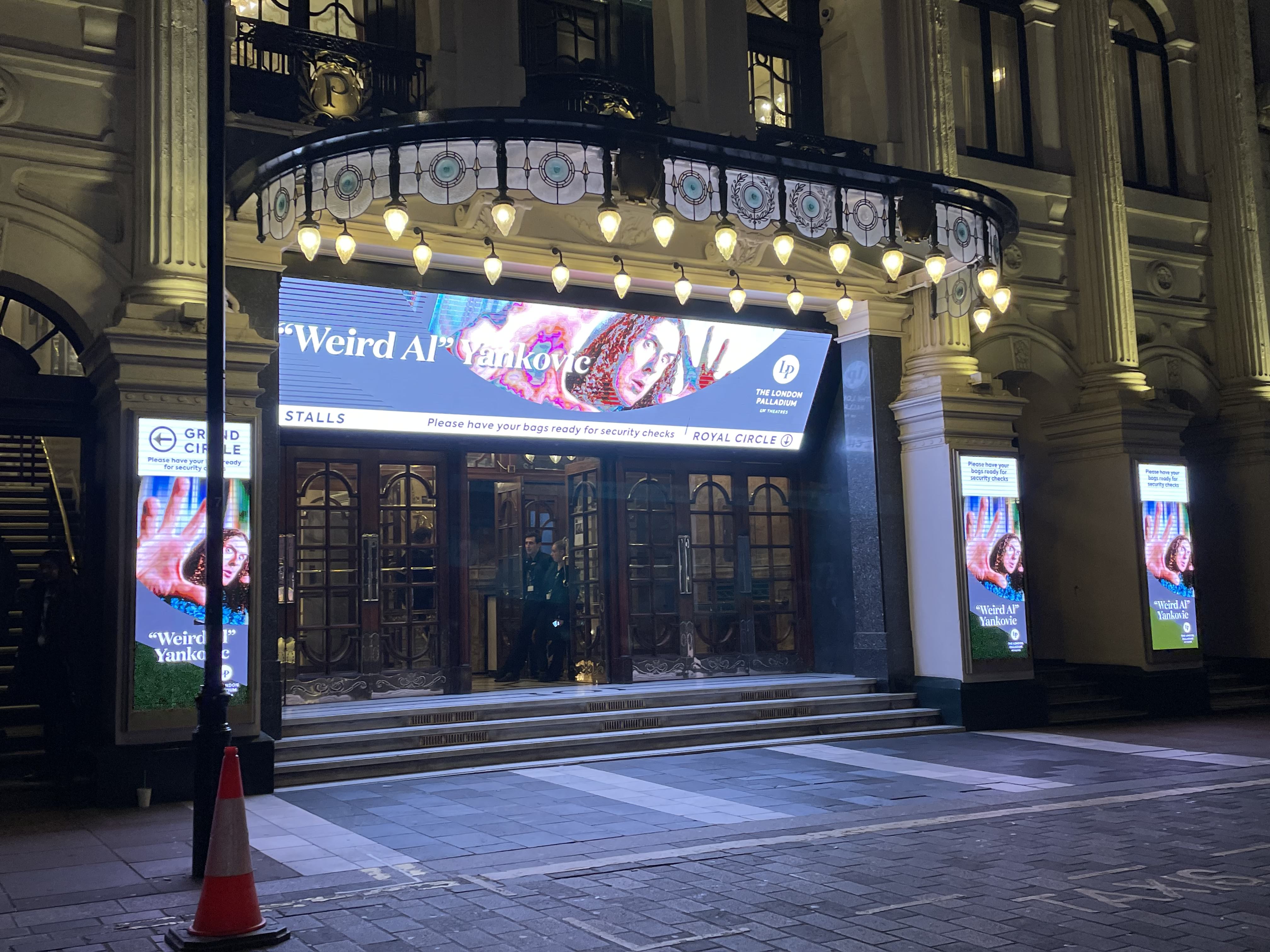
The London Palladium is one of the capital’s most celebrated theatres, having hosted shows and revues since 1910. It has just under 3,000 seats and a few wheelchair spaces. We visited earlier this week to see Weird Al Yankovic – I will not accept any shaming! – and I realised that this must be the first time I’ve actually been there since I was about 9 when my dad took me to see the celebrated revivial of Oliver! (which I now know starred Jonathan Pryce as Fagin – no wonder my dad wanted to see it!). I am familiar with Argyll Street, though, having spent many Friday evenings as a teenager rushing there as soon as I could after school to purchase tickets (in person! with cash!) from Stargreen’s box office for gigs in far less fancy venues. I have some surprising nostalgia for those years, when I didn’t worry about access issues and when £30 was considered a bit steep for a concert. When, as my erudite Welsh friend puts it, I’d throw myself into mosh pits full of 6ft+ metalheads “like f**kin Bambi on ice” despite being about as sturdy as a matchstick model held together with bubblegum. Considering it turns out that I do basically have bubblegum for connective tissue I’m amazed I never ended one of those nights in hospital, but I did come home with my fair share of giant bruises. Back then I could never have imagined going to a gig without standing/dancing/pummelling the hell out of a stranger then sharing a beer with them. I digress, but it’s amazing what I remembered as we turned into Argyll Street. Now back to our regularly scheduled review:

Getting Tickets

The Palladium is a member of the LW Theatre Group, whose access scheme allows members to book online and to book tickets over the phone without having to send proof of eligibility for wheelchair space or companion tickets every time. However, I chose to phone them for this event and there was no problem processing my order or adding the extra ticket.

Getting There

This is far easier than it used to be thanks to the fully accessible Elizabeth Line! Before it came along, if I wanted to go anywhere in the Soho, or Mayfair areas I would have to go to Green Park and go on the pavements through tourist hell from there. Taking the Elizabeth Line to Bond Street brought us out just a 3 minute roll from the theatre which was perfect.

Entrance

Next to the steps to the grand circle outside the theatre (so to the left of the image above) is a gently sloped passage where a member of staff took us through into the theatre. From there we were met by a dedicated access staff member who took us in a lift to the level of the bar and our booked space. The lift is quite small, but I was able to fit in with my midsized powerchair, my partner, and the staff member. The bar is accessible but doesn’t have a lowered area. The merchandise stand was also in this area. To get to the doors into the theatre itself there was a curving ramp integrated in next to the stairs where the access staff member was waiting for guests using wheelchairs and other mobility aids.

Wheelchair Space

The route to the wheelchair space itself and the distance between the spaces and the accessible toilet is the only negative I can find with the Palladium’s access but there is a good reason for it. We entered during the break after the support act, and the access staff took us across the back of the theatre, around a rather steep corner (it was a struggle to keep all wheels on the ground!), then down along the sides of the stalls seating. As you can imagine, this included quite a lot of “excuse me please” and “mind your feet!” because there wasn’t a lot of space for people to move out of the way. The spaces were right at the front on the ends of rows A and B, and occupied by myself and a young man in another powerchair. Because of the way the spaces were so close, if I’d needed to leave for any reasons he would have had to move out into the aisle too and it would have been quite… beepy. I can’t fault the Palladium, though. The access staff member told me that they used to have the wheelchair spaces at the back row of the stalls both to avoid the issues getting down the aisle and also to keep proximity to the accessible loo, but while this works well for the pantomime, it doesn’t work quite so well for concerts where audiences often stand up and dance/cheer and block all view for the people in the back who can’t stand up! (I remember this problem from Father John Misty at the Barbican, but luckily that was only during the last song!) We were also positioned right next to a speaker, which didn’t impede our view but did make it quite an overly loud experience in my right ear. I’m not sure if the sound system was set up specifically for that one show, though.

Services

It’s always appreciated when theatres have dedicated access staff, and it’s easy to tell when they are proper Dedicated Access Staff and not “the staff member who was put on wheelchair duty that day”. I can’t fault them at all. There was a queue for the loo afterwards and one of the staff was telling us how she was now a mental health first aider, and how she sometimes had to take overstimulated kids out of the seats to decompress, hand out ear defenders, or let off steam by dancing or stimming at the back of the theatre. It was lovely to hear that it’s not just physical disability that is treated well at the Palladium and we were very impressed with the staff there.

Toilets

There is one accessible loo at the Palladium, located through a door next to the entrance into the stalls. The vestibule which it is in also holds transport wheelchairs, walkers etc. belong to patrons who can transfer into theatre seats or collect their mobility aids after the show. The loo itself is an impressive size for a West End theatre – I was able to turn my wheelchair around to leave instead of reversing out by ramming the door – however there is no room for side transferring due to placement of bins. There is a large grab-handle on the door to close it, but the lock is a small turning one which might be a problem for someone with grip difficulties.

Overall I was pleasantly surprised and impressed. My experience of West End theatres since using a wheelchair has ranged from difficult to very difficult on the whole, and it’s great that the Palladium is bucking the trend. All the great staff in the world can’t make up for poor access, but the Palladium wins on both counts.

and now:

Airlift

27 Friday Jan 2023

Posted by ninachildish in Housing, Uncategorized

≈ Leave a comment

Tags

Housing, Mental Health, personal, relationship

Things have changed. Suddenly, or at least it seems sudden, I’m not looking for a flat to rent. We are looking for a house to buy. Together. It’s still made more complicated by disability and my lack of work, but it’s within sight. It feels sudden because for 5 years of our relationship housing was something we dealt with separately. For 5 years I tried to find somewhere appropriate to live, with the assumption I’d be there on my own. C moved between rented rooms, his own flat, here, and his family. Then the pandemic happened and he was here with me, sacrificing months of rent money to make sure I wouldn’t be on my own during lockdowns. For almost two years we were bubbled, making a go of being a “household” and learning just how much we could get on each others’ nerves but also just how well we worked as a cohabiting couple. It was that, the pandemic. Those two fraught, surreal years that now comprise a quarter of our relationship and felt like a matter of weeks and an eternity all at once.

Then more things happened, rather quickly: I inherited some money when my beloved grandmother died, which pushed me out of qualifying for housing benefit and made the prospect of getting a rented flat a lot more difficult; C got a better-paid job; my mum sold her old house and pledged the profits to me for housing. Suddenly the two years of cloudy pandemic uncertainty cleared, and we realised we’d jumped over that “together but separate homes” stage, realised we’d already been doing that for 7 years. In that time many couples have long since moved in together, and I have had many moments of upset and frustration in that time about my access needs and the horribly punitive benefits system stopping us doing it sooner. But those things fell into place, almost without us realising what picture they were creating, and soon without really having any formal conversation about it we were discussing “our home” as a real thing that was actually going to happen. Is happening.

I don’t know what kept me from truly believing it, but I didn’t think this would happen to me even over the last several years of this relationship. Somewhere in my mind I felt a certainty that I would be in a state of permanent failure-to-launch, that the brain-and-body maladies would keep me stuck living in this flat full of 20 year old ghosts, or worse – sent to live in another depressing poky bedsit in a rundown block attended by disinterested and patronising support workers. That’s where my mind kept going in the years I was looking for housing, that I would be stuck there again in a situation worse than remaining here (where I can still see scenes of violence and fear play out like holograms in every room). In all honesty, I just didn’t think about the future because I didn’t know if I was going to have one. I definitely didn’t think it would involve someone else, and there are a lot of feelings to sort through still – some “normal”, and some from the darkest recesses of my brain. It’s funny how even positive things can stir up harmful emotions when you’ve accustomed yourself to feeling undeserving. I’ve spent much of the last 6 months telling myself that I am worthy of this, that I’m not unconsciously pressuring (or hypnotising, or bewitching) C into wanting to live with me, and that he’s a grown up who can make his own decisions however illogical I find them. He wants to live with me. He wants to own a house with me. We want our life together.


Equal Access Booking: Good Venues in London

19 Monday Dec 2022

Posted by ninachildish in access, Accessible London, Disability, Reviews, Uncategorized

≈ Leave a comment

Tags

access, accessibility, Accessible London, buying tickets, disability, London, theatre

Although I review individual venues, including the booking process, I thought it would be useful to keep a list of venues (London-based for now, as that’s where I go to the majority of events) which have easy booking for disabled customers. By that, I mean being able to book online without the extra hassle of having to call or email to ask for tickets, like every other person gets to do. Some of these venues only allow online bookings if the customer is a member of their access scheme (which are always free, and remove the need to constantly provide proof of disability) and I have pointed out where these are applicable. I am focussing on the provision for wheelchair users specifically, as this is my own experience. Do please let me know if I’ve missed any venues out!

Barbican

The Barbican operates a good access scheme, and has obviously put a lot of thought into making a visit to their City Of London home a less stressful experience for disabled people. While anyone can buy wheelchair space tickets online, access scheme members will automatically have the cost of a companion seat discounted when added to their basket. Blue Badge holders can also reserve a parking space for the time of their visit up to three months in advance.

The Bridge Theatre

Sign up to access list to book online (more info to come)

Donmar Warehouse

Sign up to access list to book online (more info to come)

National Theatre

Actually a complex of three theatres – the main Olivier, and smaller Lyttleton and Dorfman theatres – the National Theatre has an access scheme that doesn’t require much personal information to join, and is more interested in the applicant’s access needs. After joining, logging in to the website allows disabled people to book both wheelchair spaces and companion seats online with no follow up needed. However in my personal experience, despite being signed up to the access list, I can only book the wheelchair spaces online for the main Olivier theatre. Booking for the other two theatres requires phoning their dedicated access line on 0207 452 3961 (11am-6pm Mon-Sat).

Roundhouse

Camden’s impressive 1,700 capacity venue is equally impressive in its provision for disabled patrons. There’s no coincidence that of the ten shows I currently have tickets for, 70% are playing here. The Roundhouse does not have an access list, instead asking ticket buyers to confirm that a member of their party has access requirements before purchasing and has a text box for additional information if applicable. This is followed up with a polite email confirming that a wheelchair space (which comes with a free companion ticket in all cases) has been purchased. In a nutshell, the venue is trusting people not to take advantage of something that is not meant for them. And it seems to be working.

Soho Theatre

Located on Dean Street in the heart of London’s historic Soho, the building is commendably accessible for its cosy space. To purchase access tickets for events Downstairs or for the Theatre without having to call the box office you must have an account on the website. After purchase, the box office will get in touch to ask if you require a seat removed for a wheelchair or if you will be transferring into the seat. They also ask you to please email with your booking reference for a free companion ticket if required. Upstairs is a smaller venue without reserved seating, and while you can buy Access tickets online, this should be followed up with an email specifying if you’ll be needing a space for a wheelchair, and for a companion ticket if needed.

Southbank Centre

This brutalist complex is one of the most accessible venues in London, and a frequent host of disabled performers too. Buying wheelchair space tickets for events at the Southbank Centre is done after simple application to their access scheme, where preferences/needs can be toggled as seen below. Wheelchair spaces then appear on the ticket seats map, and customers have a choice of either a single concession ticket, or a concession ticket and heavily discounted companion ticket combo. When viewing the basket, a notice appears reminding customers that the ticket they are buying can accommodate a wheelchair user only.

Access Review – Cabaret at the Playhouse (Kit Kat Club)

25 Friday Feb 2022

Posted by ninachildish in access, Accessible London, Reviews

≈ 3 Comments

Tags

access review, Accessible London, Cabaret, Kit Kat Club, London, Playhouse, theatre, West End, wheelchair access

It was a mission to get access tickets to Cabaret at the Playhouse but wow was it ever worth the stress! If Jessie Buckley doesn’t get an Olivier out of this I will eat my suspender belt. But onto the important stuff – the access!

Ticket buying I’ve covered here – the best advice I can give if the access phone line still doesn’t work is to email the access champion and explain your issue. Unfortunately it will still involve a phone call to purchase the tickets, which makes it not fully accessible for all patrons.

For this event, the Playhouse has been fully transformed into the inter-war Kit Kat Club. This means atmosphere – decor, musicians, dancers all in an already crowded foyer and bar area and honestly it was slightly overwhelming. If you’re prone to sensory overload, I would recommend getting to your seat as quickly as possible and staying in the theatre area. I’ve put some content warnings in too this time due to the nature of the show, they’re at the bottom in text you have to highlight to view (I am still a rookie at WP formatting, sorry!) – if you’re using a screen reader and don’t want any spoilers then stop when it gets to the content warning announcement!

GETTING IN

There is a wheelchair accessible entrance further along from the main entrance outside. You will have to get the attention of a staff member outside to radio in for someone to open the door. The door opens into the vestibule between the foyer and the seats, and such an effort has been made to evoke Weimar decadence that even that little entrance has been covered in gold fabric!

SEATS

“Unfortunately”, the only wheelchair accessible spaces at the fully-revamped Playhouse-turned-KKC are in the front two rows of the table seats, normally the priciest seats in the house. This puts access patrons in touching distance of the actors in some scenes, for a heavily discounted price. What a shame! We were allocated a lovely member of staff, who escorted me to and from the bar and toilet, and even brought us some complimentary bottles of water in case we got too hot watching the rather racy performance. Having spoken to other wheelchair-using pals who’ve been, advice is to stay in your own wheelchair if you can because the provided seats are not very comfortable (they will remove a chair for you). If you have issues being around food, be aware that some ticket options for table seats include a meal served before the show and during the interval so people around you may be eating. Also a rather important note – there is a hard rule on leaving and re-entering for the stalls area, because the aisles are frequently used by cast members during the performance. Our access host told us that there would be exceptions made for health & disability reasons but there would still be times when it wouldn’t be possible to leave and come back straight away. If you have concerns about this, I would talk to someone at the Playhouse before you book a ticket.

image from seatplan.com – table seats (where the wheelchair spaces are) in view


TOILETS

I can’t complain about the size of the wheelchair accessible toilet here (no having to pee with my feet resting on my wheelchair!), and this one at least had a door that opens outwards, but I’m yet to find a West End theatre that has enough space in there for a patron to side-transfer. However, the red emergency cord reached the floor, and our lovely access host waited outside to escort me back to my seat – a necessity because as I mentioned before, the foyer/bar area gets very very busy and being below eye level I would have had to start ramming ankles to get anywhere without him clearing a path!


CONTENT WARNINGS (highlight below to view, they’re written in white)

It’s Cabaret turned up to 11 – I’ve seen a few productions of it before (including the rather sanitised version my high school put on) but where most have been highly suggestive, this was overtly sexual. Aside from that, there are multiple instances of antisemitism (unavoidable without cutting major plot lines), references to abortion, and an incidence of domestic violence. There is also one “jump scare” in the form of an unexpected loud bang – ask a host if you want to be prepared for when this happens.

← Older posts

Support me on Ko-Fi

Buy Me a Coffee at ko-fi.com

search the blog

Categories

Recent Posts

  • Access Review: Donmar Warehouse
  • Being the football.
  • The Medication Postcode Lottery
  • The Accessible Home Project pt1: The Stairlift
  • burning

Tags

ableism access accessibility Accessible London access review Activism aids and adaptations anorexia anxiety beauty benefits borderline personality disorder bus buying tickets campaigning chronic fatigue chronic illness CMHT complaint coronavirus council crip the vote depression diagnosis disability disability services DWP eating disorder ehlers-danlos syndrome ESA eviction Family fuck tropes general election gp Hamilton health heart failure Housing hypomania incompetence London managing chronic illness Mental Health Mental Health Awareness Week mental health services microaggressions money policing mother news New Year's Resolutions nightmare personal pip poetry positivity powerchair privilege product design product review rant recovery relationship self pity shopping sleep apnea social anxiety suing a bus company theatre therapy Tories transport wheelchair wheelchair access work capability assessment

Website Powered by WordPress.com.

Privacy & Cookies: This site uses cookies. By continuing to use this website, you agree to their use.
To find out more, including how to control cookies, see here: Cookie Policy
  • Subscribe Subscribed
    • Nina Childish
    • Join 133 other subscribers
    • Already have a WordPress.com account? Log in now.
    • Nina Childish
    • Subscribe Subscribed
    • Sign up
    • Log in
    • Report this content
    • View site in Reader
    • Manage subscriptions
    • Collapse this bar
 

Loading Comments...